SCINDHI’S SWEET SHOP

The flavors of food are a huge part of a culture. Eating together or drinking together is the way that people, family or tribes, bond together. More than any other way, besides living together, it is drinking and eating together that spreads Covid. Food sucks us in. Each culture develops its own form of cruisine and there is almost nothing that someone somewhere doesn‘t cook up in some special way. In my life I have eaten monkey and peacock and goats brains and the lining of stomachs and snails and urine flavored kidney pie and octopi, just to name a few. What is disgusting in one culture is delicious in another. Every culture and religion decides what is edible and what is anathema.
But when it comes to actually describing the flavors of food it is very hard to do. We have all heard wine experts describe different kinds of wine and know that while they may be able to identify precisely what they like, when they start to use words like nutty or tart or light or peppery that the words themselves are imprecise and almost useless as a description.
Foods are cooked in so many ways with so many kinds of seasoning that while we know exactly what we like, it is almost impossible to tell anyone what we are looking for. I am going to describe my own problems with flavor and my search for a flavor that was irresistible when I first encountered it, but when I go back to find it again I can‘t describe it. I will only know it when I taste it.
This is not true of basic North Indian cooking which is pretty much the same all over the world. We are lucky in Asheville to have about six very good Indian restaurants: Mela, Chai Pani, Indian Garden, Andaaz, Kathmandu Kitchen, Cinnamon Kitchen and several smaller ones. But if you were to ask me to describe the flavors of any of the Indian food that I like so much (frozen Indian dinners at Trader Joe are almost as good) I would be unable to.
But this has created a great problem for me when I am trying to describe foods that I would like to eat again.
When as a boy at Woodstock boarding school in the lower Himalayas we were kept pretty much within bounds during the week. But on Saturdays we could roam free and a group of us boys, I don‘t remember girls being invited, would go to Scindhi‘s Sweet Shop for puries and curry. I don’t even know how to spell Scindhi‘s and I don’t have any photographs. I am not even sure that the little hole in the wall restaurant with open clay ovens and low wooden benches and tables, a grimy place, didn’t have a different name in Hindi and that it was we school boys who named it Scindhi’s Sweet Shop. I don’t even remember what they offered exactly. But I do know where Scindhi’s Sweet Shop was. I looked for it in 1970 when I first returned to India after being away for 17 years. It was at the end of a flat wide plaza running from the Majestic theater to the steep path that went up the road past the Tata Shoe Store and the yellow Union Church. It was in a little side alley just off the beginning of the climb. All I really remember with great intensity is the feeling of anticipation as we neared Sindhi’s Sweet Shop on a Saturday and the delight that I felt when sitting there eating. What exactly we had to eat I don’t remember but I can guess. I associate Scindhi’s Sweet Shop with hot puries, unleavened rolled out bread with a little oil added to differentiate it from parathas and chappaties which were thin puffed up round bread. Puries, when placed in hot oil would puff up beautifully brown and be served with a helping of potato curry. We could have a complete meal for less than a rupee when there were three rupees in a dollar (closer to 75 now). A rupee had 16 annas in it, each anna had four pice, each pice three pie. There were no calculators in those days and without the decimal system banking must have been a nightmare. There are now 100 paise (Hindi for money) in a rupee and India is as computerized as any place.
In the 1950’s Mussoorie was a cool summer hill station for the British and rich Indians, a quiet vacation spot. Now Mussoorie is connected to Delhi by the Shatabdi Express and is the escape vacation spot for the Delhi middle class with hundreds of little hotels perched on the steep hillside and restaurants of all kinds and pony rides and souvenir shops selling walking sticks. But Scindhi’s Sweet Shop is now gone forever, erased, except for the memory in my mind of intense anticipation while walking toward it and of intense satisfaction while sitting there. That is all that is left of Scindhi’s Sweet Shop and yet it is it one of my most intense memories. It isn‘t even a flavor that I am trying to describe, it is the heavenly feeling that the flavor of curries and puri caused in me. But now not only is Scindhi‘s Sweet Shop gone, and all of Mussoorie turned into a summer carnival,but everything is gone, vanished, and all that remains for me is that feeling of being fully alive eating at Scindhi‘s, as nebulous and intense a feeling as there could be, which no words can describe. And yet if I could sit there again and taste the curries and puries I know I would have the feeling again.
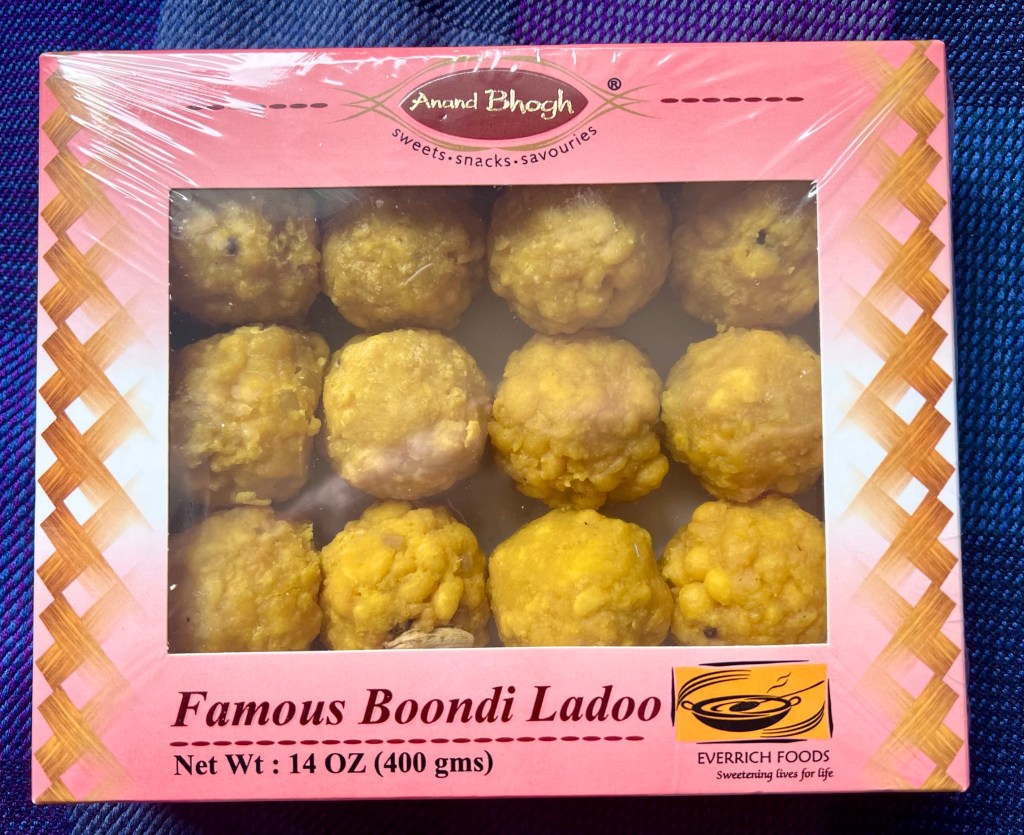
At Radha’s Indian Grocery yesterday I bought aloo parathas (potato parathas, a flat bread), a bottle of lichee juice (not available at Ingles), lime pickle, eggplant curry paste and a number of other Indian things not available anywhere else. But what I really wanted was spicy Indian snacks available all over India and discovered to my surprise a box of 12 ladoos in a refrigerated section. On our train rides from our boarding school in the Himalaya mountains to our homes on the Indian plains for the long winter vacation we traveled in school parties with a carload of fifteen or twenty children being taken on different routes to be dropped off in twos and threes where their parents lived. At first there were twenty of us having a great time together leaning out the windows or sitting in the open doorways with our feet on the steps outside or sometimes even climbing on the roof of the train car until a a student was killed by a low bridge which put an end to that. We had a great time together. Indian trains stop often at crowded platforms where you can buy hot food from food carts or sweet, milky Indian chai in clay cups. The trains start up slowly so there is plenty time to get back on when the train starts up. One of the first stops for the Allahabad party was at Hardwar, a holy city where the mountain Ganges becomes a more placid river as it leaves the mountains and makes it way to the Bay of Bengal. In Hardwar we were able to get off the train and buy ladoos, very sweet yellow balls in clay pots. They were reputed to be, by I don’t know whom, but I believed it, to be the best ladoos in India. And yesterday at Radha’s Grocery there they were, 12 yellow balls under cellophane in the sweets section of the store. All I wanted was a taste, to taste that nutty sugary flavor I remember so well, but I had to buy 12 even though I am not longer a sweets person. There were also gulab jamans, brown and equally sweet served in a thick syrup, which I have often eaten in India since I was a boy since they are often served as a dessert with puries, either gulab jamans or jalebies, curlicues of sugar fried in oil and then soaked in orange syrup. I hadn’t eaten ladoos in 70 years and brought them home to savor, almost a religious experience, by myself. And sure enough, when I ate one slowly, the old flavor was there and I felt good.
But the flavor I was searching for that I most wanted to find is one that I have been searching for for 70 years since the cake wallahs with their large tin trunks on their heads full of small oval cakes of various sizes with colored icing on top or cream rolls filled with sticky white cream, or fiery pastries filled with potatoes and meat would arrive at the school to tempt us. We lusted after the goods of the cake wallah when he opened up his tin trunk and would carefully select one or two, spending our meager pocket money, and savoring them slowly, never, never sharing them with anyone else no matter how hungrily they eyed us. But what I have most yearned for over the years was not those cakes which as I got older tasted waxier and waxier, it was channa. Channa is roasted chick peas with a hot coating of spices which are crunchy and fiery and absolutely delicious. They came in a rolled up cone of newspaper. I have never been able to discover that flavor in India again, just as I never saw another grapefruit like pummelo in India or anywhere else until I discovered one in the Swannanoa Ingles about ten years ago, brought here because Mexicans eat them. I have been offered channa in India, but it was never the same. Radha’s had three kinds of chana which I bought. I put them away until I would be in just the right frame of mind for an ecstatic experience. This afternoon I made Indian chai, half hot milk, half water, with a quarter of a teaspoon of chai spice from a packet of chai spices that Susie had given me. That should have prepared me for what followed. Because the chai, while good, was not the chai we drank from clay cups so long ago at railway stations. It was just a little off. And then I tried the three different flavors of chana, roasted chickpeas, cleaning my palate between tastes like a wine taster. One was sugary, one was garlicky and the third one with lime and chili was somewhat like the cones of chana I ate as a child but not quite. The more I ate the more disappointed I was. There was a chalky flavor that was disqualifying. Maybe they weren‘t roasted enough. So I roasted some for ten minutes and they came out black ash, I tried again for five minutes, still ash, but at three minutes they were golden brown and a little crisper but still chalky. I don‘t know what to do with them now. I can go back to Radha‘s and buy everything else with the word chana in it but I‘ve lost hope. All I can do is to make a pilgrimage back to Mussoorie and ask if anyone still makes chana in the old way and taste and taste until I find it. Or maybe, like the taste of Sindhi‘s Sweet Shop I‘ll have to be satisfied with that nameless intense memory that I still carry with me and will never encounter again.
 BILLYBABA’S WANDERING