REINEKE SISTERS, KUCHEN AND TEA
After we were first married Kathe used to talk often about growing up in Winsen and would often mention the different teachers who taught in the school where her father was Rektor (principal). Kathe’s family lived in an apartment on the second floor of the school, above the school offices, the windows to the left in this photograph.
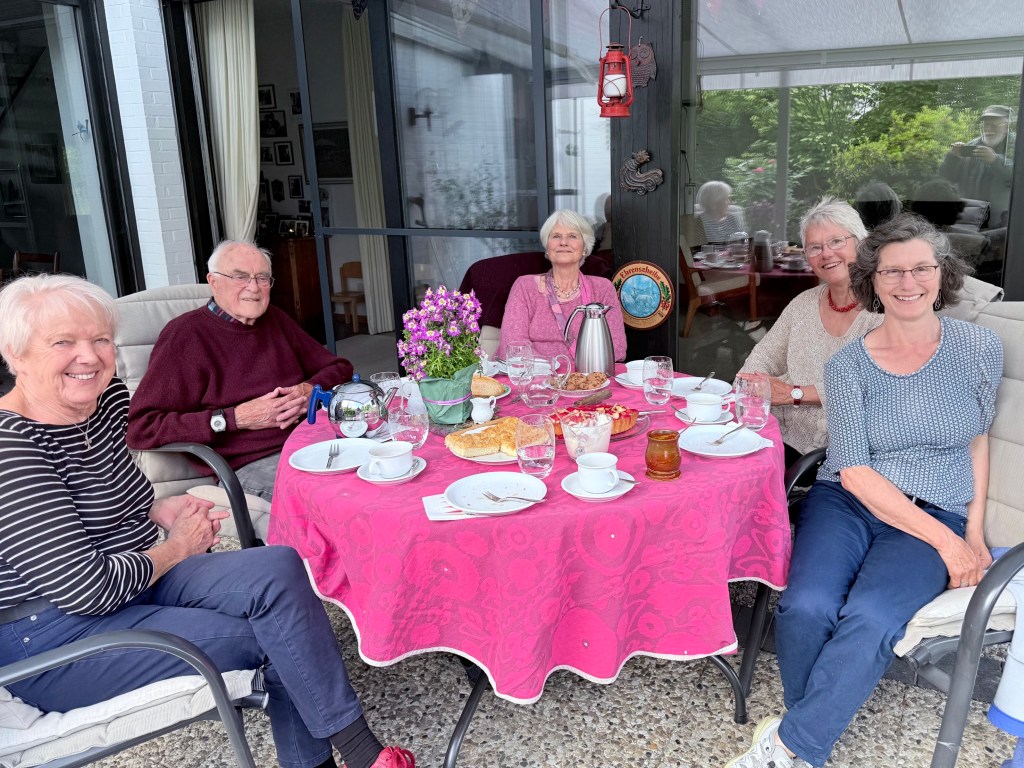
Today three sisters, daughters of Herr Reineke, who taught with Kathe’s father, whom Kathe often mentioned, came to Winsen from other parts of Germany to visit and to care for their father’s grave. For a couple of hours I listened to their stories about growing up in Winsen, only half understanding their German and what they were talking about. For some reason the world they were talking about sounded like a Jane Austen world of details about gardens and the shape of houses and friends they remembered. We sat at a round table and had strawberries on a store bought cake and almond and sugar covered Streusel Kuchen while drinking tea and coffee, the German obligatory teatime when anyone comes to visit you in Germany.

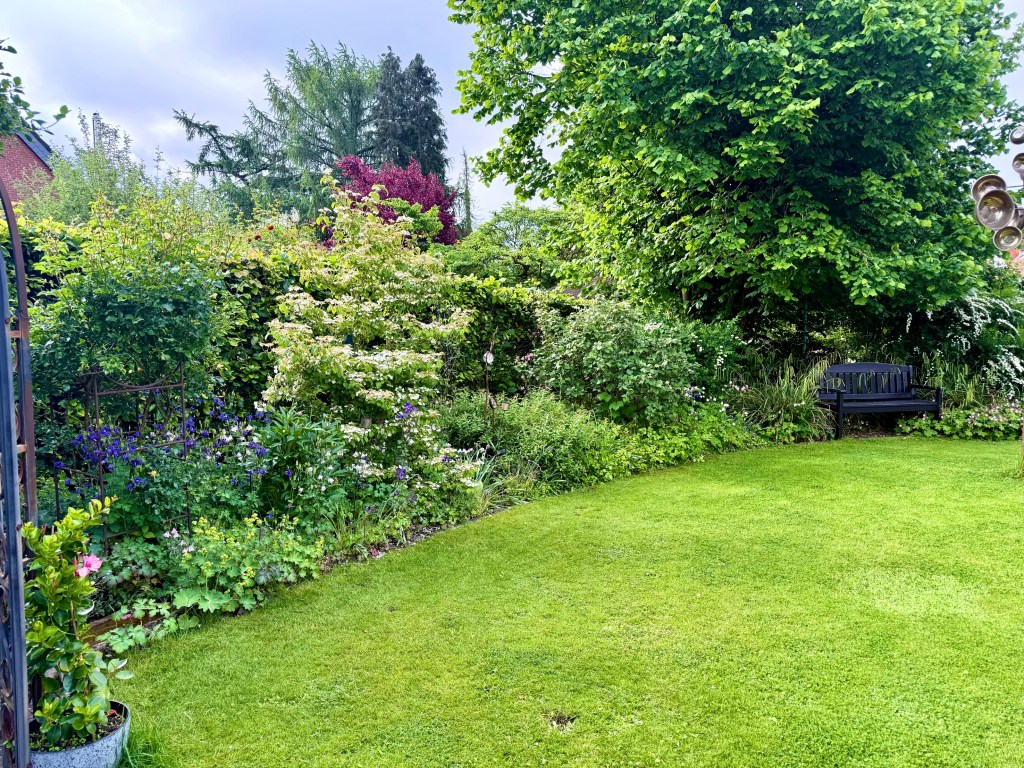
The house that Elke and Heinrich live in has a beautiful garden and a carefully manicured lawn without a weed. The neighboring house is only 30 feet away but there is such a high shrubbery fence between the two houses that it hardly seems to be there. But as we sat together through the shrubbery came the sounds of a family gathering, a great racket, in the garden next door. And from the back of the garden through another high shrubbery fence there was a symphony or frogs croaking, a strange coughing sound and a chorus of bird songs from a small pond in the garden. So we were completely separate from others but completely immersed at the same time, but able to shut out intruding sounds. One of the things that Elke has found strange in the USA is the lack of fences around houses, one lawn melds into the next and while houses are farther apart, what is happening in one yard is visible to everyone else.

I would guess that the climate in Winsen is very similar to the climate in Western Carolina, at least this May it has been. And yet the architecture of the houses is completely different. Here the houses all have high pitched red tiled roofs which easily shed snow, although our much flatter shingled roofs don’t seem to be burdened by snow and seem to allow more inner space. Why do they insist on red tiles while we insist on shingles? Here the houses have thick walls of mostly brick or masonry built to last forever and are much more solid and soundproofed inside than ours. I don’t hear anything when I am in my room and don’t know when Heinrich and Elke are in their rooms or in the living room. Our houses have flimsy wooden two by four dividing walls covered by thin sheet rock. Here every house is fenced and the very solid doors double lock. There is much more a feeling of security and privacy. And here gardens are much more beautifully tended than ours.
I discovered during the two hours of conversation in German that there is a change happening in German cemeteries that reflects both the well tended gardens and the maintenance of the family garden plots. It is because Germans feel a need to tend the gardenlike plots of their dead relatives that, as they increasingly move to cities far from the villages where they were brought up, like the Reineke sisters, that they feel badly when they can’t tend the family burial plots. One solution is to pay a gardener to care for their family plots when they can’t tend them, which is one of the reasons the Winsen cemetery seems so well tended. Another solution is to allow people to keep a burial plot for only 25 years after the last person is buried, after which the family either pays a high fee to keep the plot or it is dug up. By that time families have let go of the dead and tending the gravesite is a burden. A third way is to be buried in a manner which they call “anonym” which is not really anonymous because a plaque indicates that a person has been buried there but the burial spot is soon dug up so someone else can use it. There is no spreading of ashes, as in the USA. Families are not allowed to have the ashes which are kept by the funeral home and properly buried in an expensive casket and an expensive gravesite. And behind all of this, the closeness of the houses and the permanence of houses and the security of houses and the fact that zoning strictly determines where and how people can build so that everyone lives in concentrated villages with large stretches of fields and forests with no house on them is the fact that Germany has a large population on much less land per person than the United States and everything has to be done to make the best use of the land and to allow people to live in close proximity to each other without causing anxiety or tension. It is almost the opposite mindset of Swannanoa where there is a fierce rejection of zoning or any government control with everyone building how and where they please.
So as the Reinecke sisters were reminiscing about the Winsen past and their childhoods as they came for their once a year tending of their father’s grave, I was thinking how the German mindset circumscribes their thinking and how the American ideas of individuality and freedom circumscribe my own and how the MAGA/Liberal tension is between individual freedom and homogeneity and liberal openness to regulations that make living together easier and encourages the acceptance of differences between people.
 BILLYBABA’S WANDERING