BUILDINGS
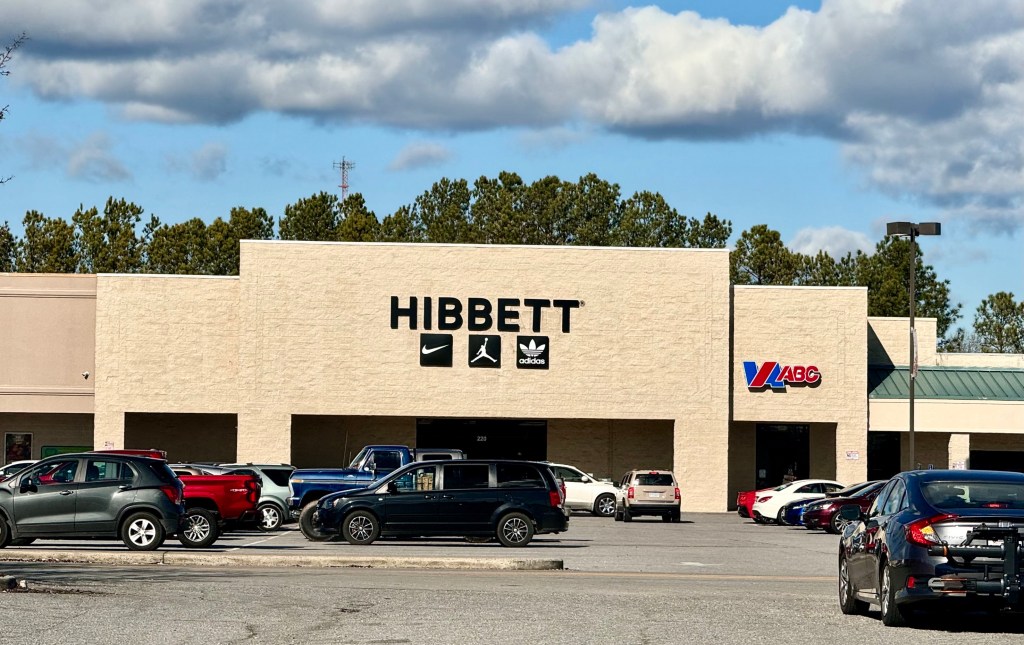
In the last week I’ve been disturbed by the strip malls along the highway both on the way to Virginia Beach and in Swannanoa. But I am beginning to question my dismissal of everyday architecture in the United States. I am a little uneasy with my unthoughtout response.

Why is it that the buildings on the Greek islands seemed so attractive, and the houses and store fronts of the places I’ve been to this last year in Helsinki, Finland and Haarlem, Netherlands and Winsen, Germany and Paris, France. So I’ve gone back through some of my photographs during the last year to see if I could pinpoint the reason I feel this way.
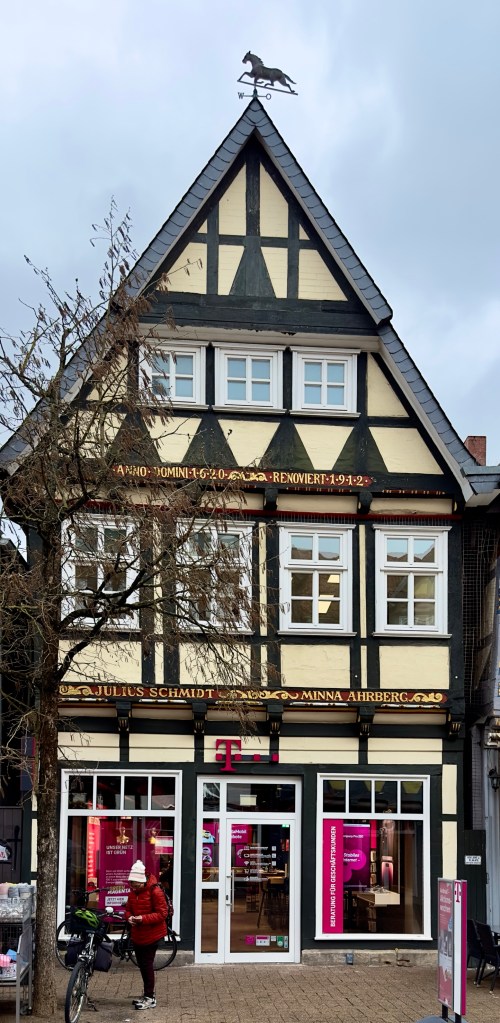
Age. One of the huge differences is simply the age of the countries that I have visited. The buildings in Winsen, Germany, my wife Kathe’s home town and the nearby town of Celle date back hundreds of years. Celle, was unbombed during the Second World War because it was the birth place of the Hanoverian kings, the Georges, who became kings of England. The houses are all from the 15th and 16th century. It is only the outer shell, the brick and brick and timber criss cross framework that is preserved from the 16th century. Inside the buildings are all modernized. The street in front of them is usually cobblestone. So the attraction here is that the whole town of Celle has held onto the old. But the same is true to some degree of Naousa in Greece and Taormina in Sicily and Haarlem in the Netherlands. The construction methods have changed but the traditional shape of the buildings has stayed the same.

This is true of the peaked roofs of buildings in Haarlem which once had an attic storage area with a top floor that jutted out a little so that goods could be easily lifted to any floor. The Netherlands was a trading country and this was practical. But now when the attics are no longer used that way the shape of the buildings has stayed the same. And the houses and shops of Naousa are constructed with a steel beam skeleton but the masonry shape of the outside is curved and and rounded and always white with blue accents. The basic look of the houses, including the cave like interior of the airbnb’s we stayed in have often remained the same. In any case, remaining true to tradition gives the buildings in all these countries the feeling of being both very old and very solid, built to last forever, which they often have done.

In the USA the strip malls don’t seem to be based on a traditional model. The model seems to be a cheaply constructed box with a fake triangular or raised wall on the roof. If there is any model it is the frontier saloons and hardware stores with a fake front to make them look more impressive, most of which have collapsed with age. The strip malls seem to be aimed to have a life span of ten years before they begin to deteriorate and becomes the home of start up businesses, often run by enterprising immigrants.
 BILLYBABA’S WANDERING