MAGIC MUSHROOMS AND THE PRESENCE OF GOD
A chapter in Entangled Life on psilocybin, the key ingredient in magic mushrooms made me wonder about my perception of the world.
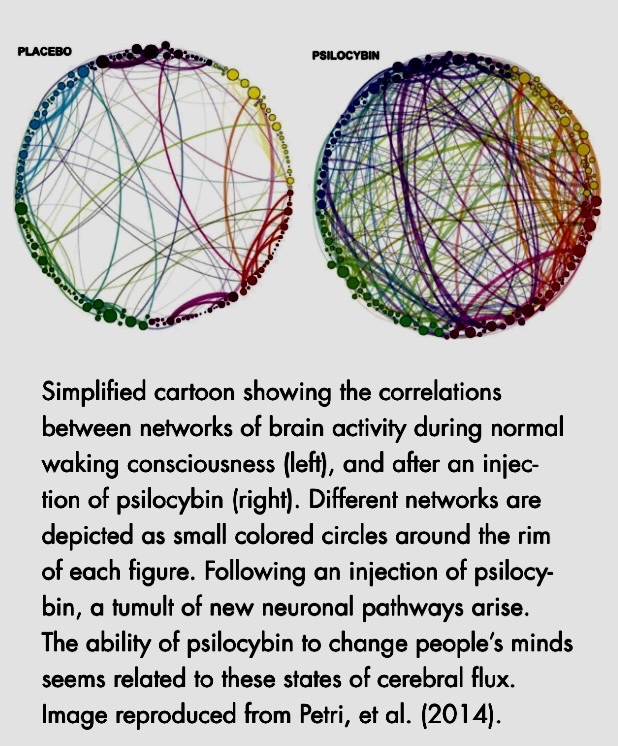
A an illustration shows the effect on the brain of this compound produced by magic mushrooms by showing how the brain pathways are altered by the drug.
Apparently in 1928 a Scottish physician had cultivated disease causing bacteria in a petri dish and discovered that a mold of a fungus had contaminated the contents of his dish and was destroying the bacteria. That led to the discovery of penicillin, a natural product of a fungus which with later processing was refined into an antibiotic that saved thousands of lives during World War 2. The fungus produced this product simply to defend itself against bacteria without having humans in mind. I had heard this story retold, but in my mind it was Alexander Fleming who was the hero of the story, he is the person who discovered penicillin. But the hero of the story is not Alexander Fleming, it is the Penicillium mould that is the hero of the story. Scientists learned to cultivate the mould and found ways to store and administer to humans the bacteria killing substance. A similar thing happened with the the discovery of the powers of magic mushrooms by shamans and healers in Mexico. Shamans didn’t invent psilocybin, they discovered that certain mushrooms had a hallucinatory effect when eaten.
It turns out that in addition to all their other almost magical productions, fungi have also produced drugs with magical healing properties. We just weren’t paying attention.
Of course I have no idea what the science is of what is going on here and am learning of this, at best, third hand. But what interests me is how this makes me wonder about how fungi perceive and respond and how humans perceive and respond.
How do we perceive in the first place? What psilocybin does is to alter the way you perceive so that you see in a new way. The question is whether your vision is altered so that you see things that aren’t there, so that you are hallucinating and imagining what you see, or whether you are seeing things that you couldn’t see otherwise. Are we limited in what we can see as humans? I don’t know how we perceive in the first place. I don’t know how or why we see as we do.
Where this started for me is when I read a book on William Blake, Fearful Symmetry, in college and read that William Blake insisted that the angels he saw sitting on his mantelpiece were absolutely real. If other people didn’t see the angels it was because they couldn’t see as well as he could. He was a seer and was able to see more than others. This led him to write enormous mythological epic poems which he illustrated with his own drawings and printed up on his own printing press. I didn’t read much of Urizen or any of his other mystical mythic poems. They seemed to fantastic. But I did wonder how he so clearly saw what he saw.
But now that I am older his epic poems don’t seem any more fantastic than The Book of Morman, the Bhagavad Gita, the Koran or the Bible. People who wrote those books were seeing angels on a mantelpiece, they were seeing things that I can’t see. And not only did they see, and feel intensely the presence of the sacred in these books, but their followers insist that what was being perceived in any of these sacred works is more real than the everyday world that all of us can agree on.
I read yesterday that the Swedish consulate in Iraq has been stormed by fundamentalist Moslems furious that Sweden allowed the burning of the Koran in Sweden because the Swedes accept the attacking the Koran as an act of freedom of speech. The Swedes defend the right to speak freely and the Moslems see the desecration of what they feel is most real, what most needs to be defended, something that the Swedes apparently couldn’t see.
In my own plodding along way I have always wondered whether what is real is what we all can agree on which is the realism of the profane and mundane world in which the Koran is simply words on paper, an ordinary object. Or whether what is most real, is what touches us most intensely, which in this case is the Koran as sacred text, the sacred words of Allah dictated by Mohammed.
As I pass through the world some people and events and objects seem to have profound intensity while others don’t. And I’ve always wondered if this power is in me, who perceives, or in the events or objects being described, often in story form. Is there something in me that recognizes certain outside stories as having an electric sacred power, or is there something in me, some inherited archetype, that is touched intensely and transforms an ordinary object or person into something sacred?
Romance seems to have this odd power. Of the whole range of women or men why do humans settle on one person who makes them feel fully alive to mate with and become entwined with for the rest of their lives, or at least as long as this intense response remains strong? Does that person have this tremendous attraction within them or is there something embedded in each one of us that finds one person supremely attractive?
But this seems also true of the power of the presence of the many gods in India, any one of who can make a particular person feel very alive. It seems true of the power of Jesus who many people feel is more real and intensely alive than any actual person they know. Is the power within Shiva or Kali or Jesus, or is this intense response something embedded in the individual projected onto a god? What is most real, my perception or the god I worship?
Does any one of us as a seer see something intense that many other people don’t see at all?
And this brings me back to magic mushrooms and psilocybin, the compound developed in a fungus that alters the vision or the people or animals who eat it. If the effect of eating the mushroom makes an animal or person feel more alive they will eat it and then spread the spores of the fungus wherever they defecate. That is a simple objective explanation for psilocybin.
But what this makes me wonder about is the connection between what I perceive and the way I perceive and whether a substance like psilocybin lets me see more, and more intensely, than I see without out it. Is William Blake seeing more than me or is he nuts? Was he on some kind of drug?
But if we reduce everything to the lowest common denominator, to what we can all agree on, reduce everything to the Sancho Panza level, then everyone who sees and is turned on by something that others aren’t, is nuts. But that includes everyone who is enchanted by a particular Dulcinea, as Don Quixote was, a form of life enhancing illusion. All romance is nuts, falling in love is nuts. All religions are nuts. Most poets are nuts and most musicians and painters. Is Picasso a genius, showing us a new and more intense way of responding to the world, or just a guy who can’t draw very well who draws cockeyed one dimensional figures?
Am I nuts when I exclaim how beautiful a sunrise is when someone else finds it ordinary and not worth getting out of bed for?
So, as you can see, I am getting all tangled up here and it is caused by more than magic mushrooms, it is caused by my not being able to put my finger on what is most real, by not being able to decide whether William Blake is more alive than me or if he is cuckoo as he sits in his garden naked having intense visions beside his tolerant wife. What did Mary think when her son said he was the son of God, born of a virgin birth? Did she correct him in any way or was she blown away?
Are all of us living in a heightened reality, are all of us, half the time, on some form of magic mushroom?
 BILLYBABA’S WANDERING