LANDOUR

Our third evening in Landour we at at the Ivy Cafe, part of the Hotel Dev Dar Woods. Susie and I have been staying at the Hotel Dev Dar Woods together and separately for the last thirty years. The hotel was run by Anil Prakash whose father ran the Prakash general store in Sister’s Bazaar at the top of this mountain in the lower Himalayas on which Woodstock School was built 150 years ago. Sister’s bazaar has a long yellow building where the sisters lived who were nurses in the mountain hospital for British soldiers who were recuperating from various injuries and illnesses on the plains of India. It is a remnant of India’s colonial past, just as Woodstock School is a remnant of India’s missionary past, also a colonial outreach, of which I grew up a part.

Because of the British contonment policies no new construction has been allowed on this hilltop and is still not allowed, only repair are allowed. So when whatever mission that had built and maintained this house for their missionary families to come to during the summer when the heat on the plains was unbearable, left India after Indian independence in 1947, both for financial reasons and because they were unwanted as part of the colonial past, Anil Prakash bought the house and turned it into a modest hotel without changing its structure in any way. The glassed in porch on the front of the building became a dining area and the living room of one family the shared sitting area. All the bedrooms off a long hallway were turned into guest rooms.
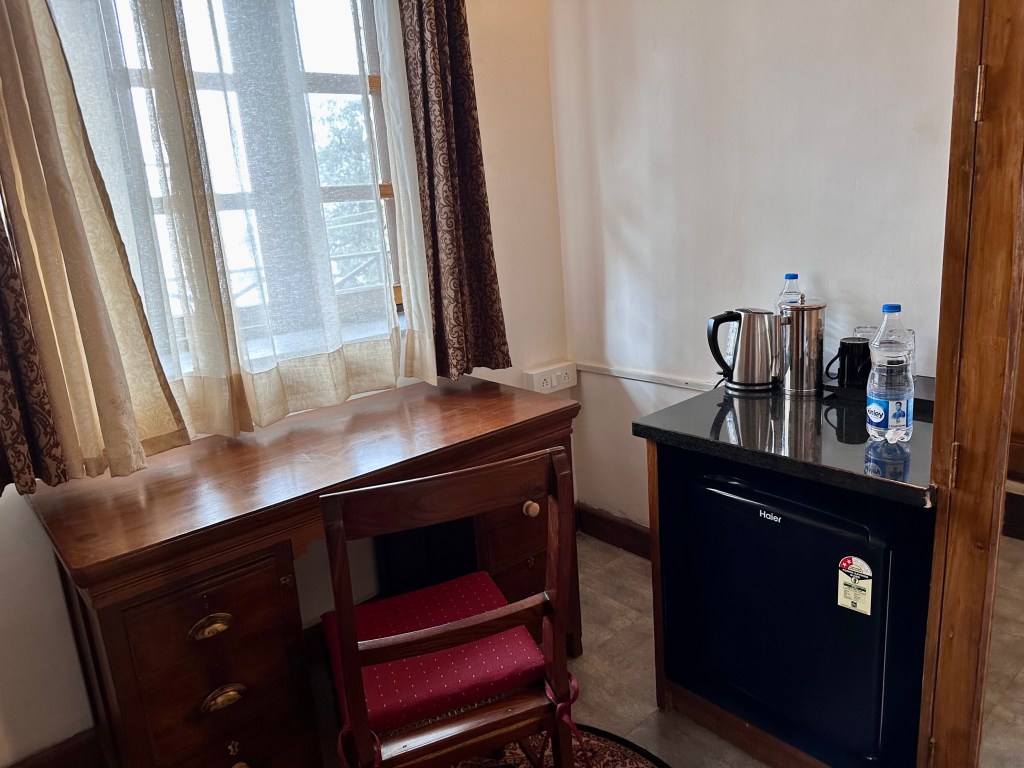
It was a very simple hotel, very cold in the winter in spite of wood stoves in some of the rooms, with simple food and accomodations for twenty or so people packed into the guest rooms. I discovered it about 1986 and brought a number of groups of students here on our two month or four month tours of India for a few days. From here a group called MGVS, a mountain development group arranged homestays in Himalayan villages. And from here we would board a bus and make a long bus ride to Gangotri, the holy city at the source of the Ganges and from there we would make a twenty mile trek up to Gaumukh, the headwaters of the Ganges as it poured out of a glacier, a glacier that has been receding year by year since then. It was a great adventure for the students and it brought me back to Landour again and again.

So last night we had dinner in the Ivy Cafe in the Hotel Dev Dar. Under the repair rules of the cantonment, the building has been completely refurbished, not a word that can be spoken. It has been repaired, leaving only the red tin roof and the walls. Nothing else is left from the old Dev Dar Woods except for the giant Deodar tree in the wide front patio of the hotel. The view of the high Himalayas is still there through the straight trunks of deodars, it is still as silent and peaceful but the price of accomodation has jumped from $4 for students and $15 for room and breakfast to about $120 a night with complimentary breakfast. We are here through our long relationship with Anil.
But the change in the Dev Dar Woods is also the change in India in the last 30 years. There is a new fast four lane expressway from Delhi so that in the sweltering summer people can reach here in three hours and spend a week in the coolness and silence of the Himalayas. Rokeby, an old mainline missionary house, which became an evangelical guest house when the mainline missions left is now a five star hotel with a $150 price tag and a very nice restaurant with all kinds of westernized food. In the sister’s bazaar is the Landour Bakehouse with croissants and all kinds of pastries and a great variety of exotic coffees which was filled today with young Indians who drive up by motor scooter

.
So the old India that I grew up in is shifting as rapidly here as it was in Assi Ghat with the large number of trendy cafes and restaurants with neon signs all moving in the direction of trendy Khan Market in New Delhi.

So that is where we were sitting tonight. I was eating a very tasty chicken, onion and tomato pizza with a crisp crust. The music playing was twanging mountain hollow country music with one mournful song being about the lust created in his love by his new pickup truck, followed by a rendition of “Coward of the County” written by our friend and neighbor, Billy Edd Wheeler. Young Indian couples in slouching blue jeans and loose sweaters who would have been unnoticed in Asheville, were eating pizza and drinking coffee. Outside in the dark was the line of 20,000+ peaks that we had seen this morning. Last night a hail storm hit and thundered on the tin roof of the Dev Dar Woods reminding me of my boyhood days during the monsoon when the thunder would crack over our heads and the night turn blue with lightning and the rain would pour down for hours on the tin roof. The storm cleared the air leaving the first really fresh air I’ve breathed in a month. And in the morning the high peaks of the Himalaya were clear to see.
But tonight the surreal quality of our trip finally caught up with me. Only a few nights ago in Assi Ghat the Shiv Ratri streets were filled with streams of red footed pilgrim boys, the lanes of Assi ghat were filled with pilgrim groups from all over India on their way to the Ganges, the horns of all kinds of vehicles shrieked against each other and loudspeakers blared away. That is the old India and here is the new India, silent and peaceful and hip with country music providing ambiance as I ate thin crust pizza. Two different Indias, so different that I can hardly keep them in mind side by side and only two of the four Indias we have been immersed in since we were here. First, and every couple of weeks for a day or two, have first been the wide streets and grey smog of Delhi, next was the barren desert and jagged mountain landscape around Virampur, Gujurat, and the thatched roofs of tribal villages with their hearts of goats and sheep and buffalo and the wild colors of the women’s tribal outfits and the multi colored turbans of the men. And then came Assi Ghat and the overwhelming rush of people and sounds and sights. And now, finally the utter quiet and peace of Landour and the huge emptiness of the mountain valleys. It is almost too much to put together.
People ask me why I keep returning to India and it is for the experience of each one of these Indias, one so different from the next and all so different from the homogeneity of the United States in spite of its great regional differences.
But when I think more about it I experienced each of these Indias at a different time of my life and the feelings each places evokes touches me in a different way and that is one of the things that I want to wonder about.
 BILLYBABA’S WANDERING