(REALLY FEBRUARY 22, 2019)
PILGRIMS
Todd, Susie and I are settled in the Sahi River Guest House with a wide glassed in porch where we sit with a view over the Ganges. It is $13 a night, so we could stay here forever, but we have only three weeks until we got to Mussoorie in the Himalayas for three days, Istanbul for three days and then France for a week and then home. So now we have a quiet time with Susie working on an art project, Todd reading and me photographing and sitting here and typing.
Each day we go out to eat in some nice restaurant or to do some errand. And whenever we go out something happens. We never know what it will be.

Two nights ago we walked to Ibo, a very pleasant Japanese restaurant with terrific food. On the way there we passed images of Sarasvati, the goddess of learning and the arts, being put on large carts. On the way back we encountered several of these images, about ten feet high, being pushed through the street with a truck with a wall of loudspeakers moving slowly in frontier it with music so loud it was hard to breathe and behind it young men, their faces smeared with yellow, were dancing frantically. Each little procession was going to go down the street and then finally be taken to the bank of the Ganges where after a dance party the image of Sarasvati would be tipped into the river and washed away.
And then yesterday we saw a different kind of religious devotion, a different kind of pilgrim. We were in the AUM Cafe having breakfast on the rooftop of two story building covered with upbeat suggestions for living a healthy and peaceful life. AUM is the sacred sound embodying all of the Sanskrit sounds, a holy sound. The proprietor is an American woman with a pony tail who wears red robes and preaches the Ayurvedic virtues of the herbs she uses. No meat, no eggs, no sugar. But for us the virtue of the place is that she washes the vegetables in filtered water so that the food is safe as well as being dietetically proper. Even so the AUM is a little far out by Swannanoa standards. It is filled mostly with whities from one country or another.
At the table next to us were four American men, dressed in white pants and T-shirts who were loudly organizing some project. They were all alpha males, trying to out organize each other. “Give me 15 people and I will clean up the second floor, give me twenty people and I will clean the windows.” They talked as if they were in Lowe’s and seemed to have no idea of how Indians might do the tasks they were overseeing and with no Indian liaison person to guide them. As far as we could tell they were preparing for the grand opening of a place called Tango, which we assumed to be a restaurant. They were going to advertise the place by offering free food. It seemed like a hopeless American attempt to make money in one of the most chaotic and inscrutable of places within a culture they knew nothing about. Or that is the way it seemed to me. We were amazed.
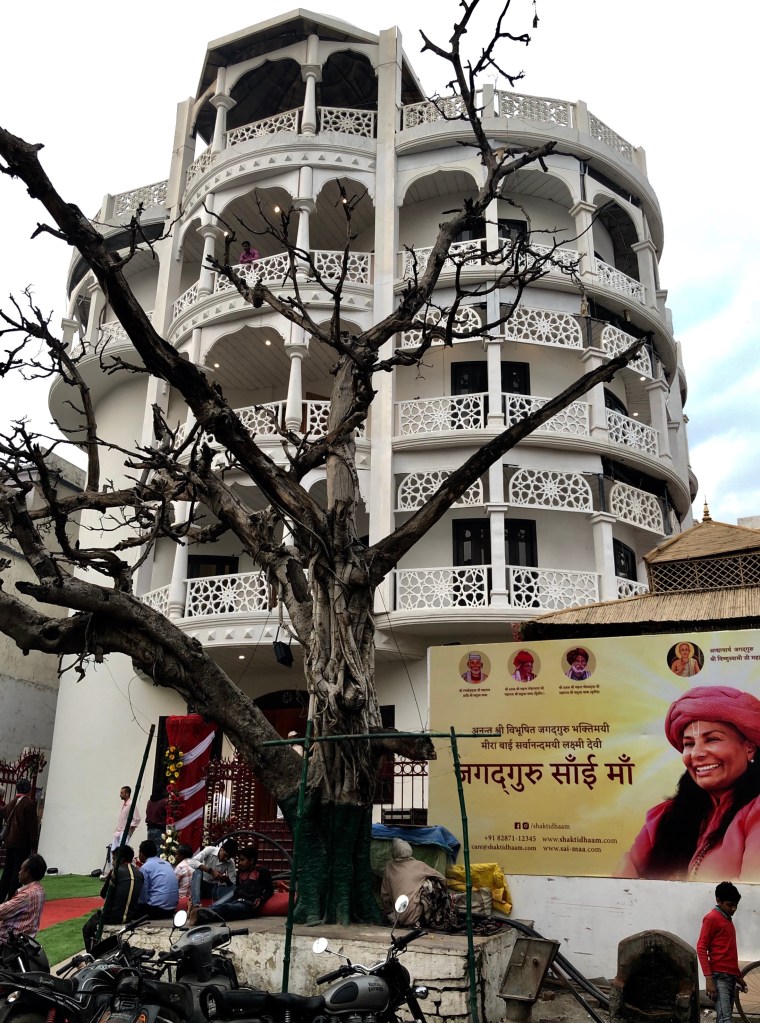
But the next morning when Susie and Todd were going on a morning walk on a narrow lane leading to the center of Varanasi they stopped for tea at a tea house where a very old woman crouched in a tiny shop where she sold cups of tea in small paper cups for the equivalent of 5 cents apiece. While drinking the tea they heard a hubbub in a brand new four story circular building around the corner. Susie looked around the corner and there was a large group of obviously well to do people, mostly Americans, and among them were the four men we had seen the day before but in flowing white Indian pants and kurtas who were helping to conduct some kind of ceremony. Todd and Susie couldn’t believe it.
They continued their walk and came home to breakfast at the AUM. We asked the red outfitted woman at the AUM what was happening. She had been to the grand opening that the men had been preparing for the morning before.
The newly opened building was Shaktidhaam Ashram, shaktidhaam means giving appropriately according to your means. For $1,500 you could save the soul of a friend, for $2,500 your own soul and for $5000 something that I can’t remember. Jagdha Guru Sai Ma, a middle aged woman dressed red, apparently a European, this was her holy name, was the guru of this brand new ashram.
The AUM lady was incensed by a number of things. One was that the guru lady was sitting on a golden throne with a parasol over her head and two white guys (one was one of the Lowe type organizers we had seen at the AUM) in orange and white robes were fanning her with yak tails because the ceremony was inside and there was no chance of rain, no need for a parasol. But she was even more incensed when one of the Moslem musicians that she knew had a red dot, a tikka, which she identified as a third eye, placed on his forehead, indicating that he had had a religious conversion. This was a no no from her perspective.
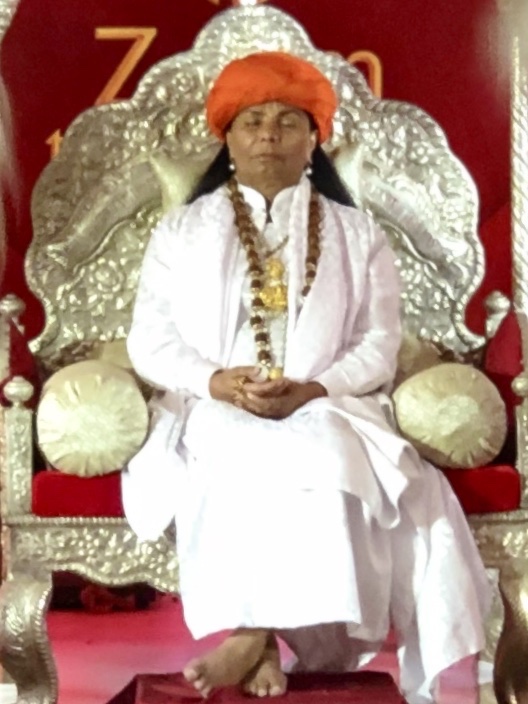
It turns out that the Guru lady had rented a huge tent at the Kumbh Mela, a giant gathering of pilgrims and sadhus that happens every 12 years where up to ten million people at a time come to bathe in the sacred confluence of the Ganges and Jumna rivers, at Allahabad 100 km away, incidentally only a few miles from the twenty foot ceiling house where I lived in the winters in Allahabad when I was a boy. Her devotees were flown in from all over the world to be in her presence. They want from the Varanasi airport to Allahabad in two special train cars attached to trains that were otherwise jammed with Indian pilgrims. This was the Guru’s third Ashram. The first is in Florida, the second on some island off the coast of Africa, and this white building was the third.
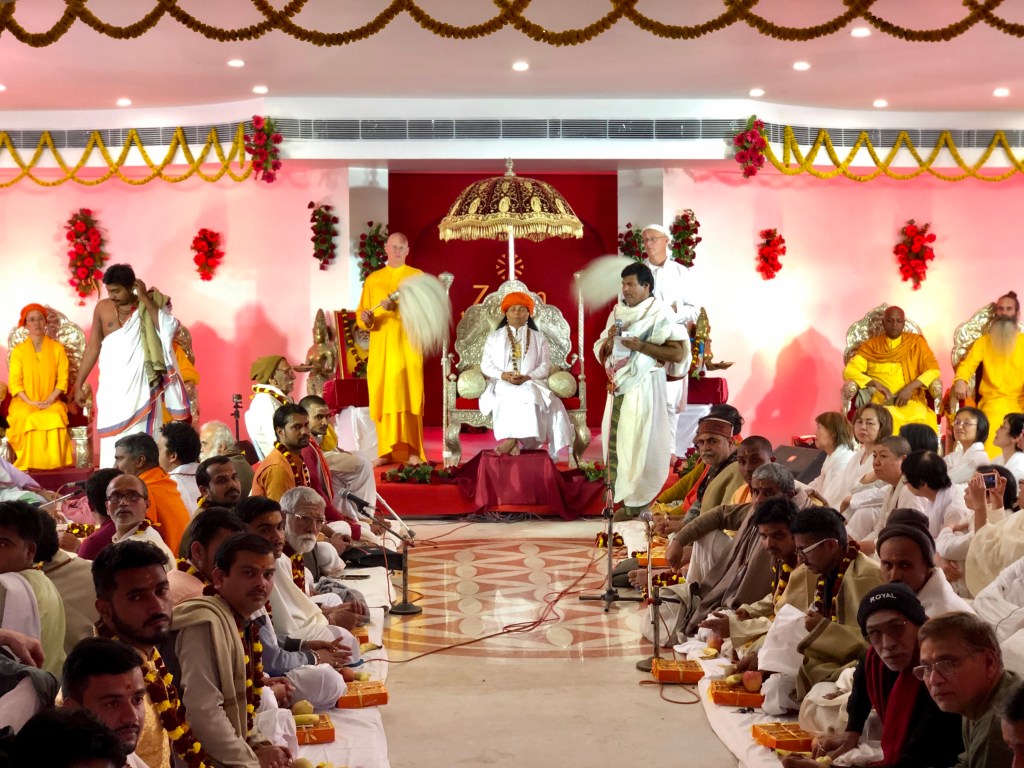
It all sounded so fantastic, the all American Lowes organizers in white waving yak tails that we decided to walk past the Ashram on our way to buy Susie stationary supplies. And sure enough, it was just as the AUM lady said it would be. There was the Guru looking bored. There were professional photographers and an elaborate sound system with priests chanting in Sanskrit. We were allowed right in but any ordinary Indians who wanted to visit the Ashram are shooed away. According to the old tea lady’s son, no Indians were allowed unless rich.
So that was our experience in two days. The dancing of ordinary Indians with a wild abandon in front of Sarasvati seemed normal here in Varanasi. But the goddess they were worshipping is one that almost no Westerners have heard of, an invisible goddess, except to 1 billion Indians. What is it about Sarasvati that provokes the same intense enthusiasm as Jesus does at the Swannanoa church our Friday McDonalds old men’s group were invited to by the guy who believed Obama, a secret Muslim, was born in Africa? What is the source of this born again intensity in both places? And how does it relate to rich Americans flying to Varanasi to sit in a tent on the sand between the Ganges and Jumna rivers at the foot of a European Hindu guru in a mass of humanity and then to stand beside her waving a yak tail fan?
Assi Ghat, where I am sitting, welcomes pilgrims who bathe in the Ganges every day and is full of shrines. Last week when I took Kathe and Elke to the center of Varanasi it was so jammed with pilgrims who had come from the Allahabad Kumbh Mela as it comes to an end that the main roads were closed to traffic and our cycle rickshaws ended up single file going through lanes barely wider than the rickshaws themselves in order to get even close to where we wanted to go. There was a crush of pilgrims held in lines by bamboo barriers that stretched for at least a mile who were trying to visit the most holy Shiva Temple, Vishvanath Temple. Kathe and Elke at 79 had to squeeze between the double row of bamboo railings holding in the pilgrims then squeeze past the people and then out the other side between the bamboos to get to our restaurant. This is a holy town, said to be the first city of India founded by Shiva himself, and there are signs of holy places everywhere.
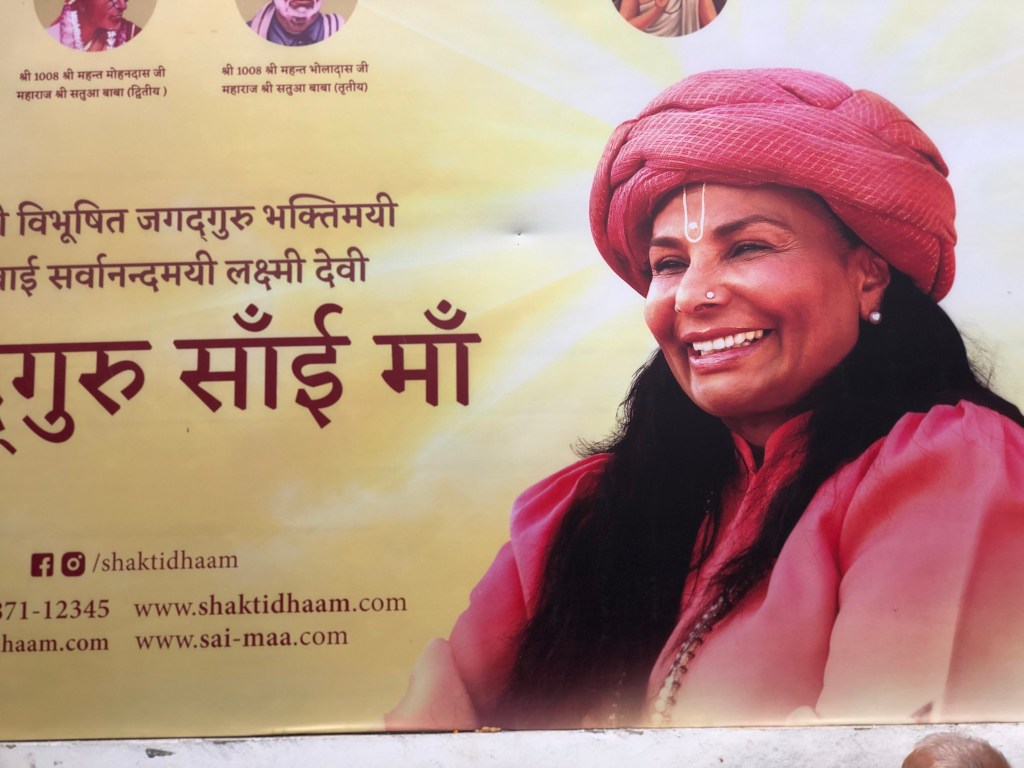
So what am I to make of the presence of the sacred everywhere so powerful that it can make Americans, who have little idea of Indian culture or the inscrutable overwhelmingness of 10 million bathers crowding into bathing spots in muddy and polluted river waters induce them to wave yak tails over a European woman who seems so obviously to be a con artist, especially to practical Lowe’s type alpha males. What force can do this and why is it universal?
Yesterday as I was sitting here on the porch in the sunshine on a cool day with the sounds of Assi Ghat all around me I suddenly felt good. There was no reason to feel good, I wasn’t consciously meditating, I was thinking of Swannanoa and how here in Assi Ghat I have left Swannanoa behind and left Trump and his wall behind and Lowes and MSNBC and Ingles and everything American even though on my iPhone I can look Kathe in the eye and talk to her anytime that I want. But I had simply let go. I was reminded of the surgeon we talked about years ago on an old man’s Friday morning who abandoned his tension filled practice and his wealth and rented an apartment on the boardwalk at some California coastal town and roller skated for hours every day, completely letting go of everything and floating along, completely free, his mind empty. This seems to be what Buddha’s meditation and yoga and the meditation of Benedictine monks is about, floating free and being filled with some power of the sacred and feeling fully alive. Instead of regretfully abandoning the sensual pleasures of the world, simply letting go completely and floating free.
Of course, at this point I am on my own. I don’t know what happens with anyone else and I certainly am not going to try and persuade anyone else of anything. But this letting go and being completely open and floating free seems to be a condition that is similar to being aware of the sacred. It is more than being aware of the sacred, it is being empty and open and suddenly being filled with some inner connection with something, gods or playing the piano or looking at the stars or taking photographs or laying out electric trains, that makes a person feel fully alive.
I read an article in The NY Times yesterday on consciousness and whether animals are conscious in ways that we think are conscious. Luckily, I don’t think there is any scientific definition of consciousness, but since I was dropped into a scientific age and have to make my way along thinking the scientific view is real, I wonder if, human consciousness can be separated from animal consciousness. We are conscious of our own pain and delight, but Jains argue that all of animal life and even plant life is conscious of pain and delight, which is why they are strict even in their vegetarian diet and wear a mask to avoid causing pain to insects and walk rather than ride to cause the least pain possible.
All of these leaps in thought, without much more support than intuition, are part of a realization (or a projection) that when I write in my journal, as I am doing now although in a form that might be shared, what I am doing is trying to be aware of my passage through life. But I feel fully aware, not when I have a scientific explanation or understanding of the (constantly changing) facts of existence but when I am aware of what makes me feel fully alive and what outside or inside me immobilizes me and suffocates me. I am aware of my feeling along passage. There is nothing universal about it. Everyone is dropped with different visceral drives in different places and different circumstances and at different times and all of us need to feel our way along as best we can. Being conscious is also a feeling, so being as aware as I can be makes me feel good. But it is the process of being aware that feels good, not what I discover for myself. And I have that feeling that in the evolutionary cycle animal life feels its way along even through the built in patterns of behavior in the genetic code to what feels good. Maybe this at basic level is what tastes good, what is comfortable, what feels good in every way and this drive to be open and respond is what draws all life, conscious or not, to make its way as best it can from birth to death.
And maybe that is all that we are doing, or at least, all that I am doing. I am just feeling my way along.
And it is easier to do this when on the banks of the Ganges I let go of all the expectations of American cultural patterns and simply let go and float along.
Of course that is just me. But I sensed some of that letting go and floating and being open to the great whatever, either in us or out there, that those young men with yellowed faces when dancing in front of Sarasvati, goddess of music, whose presence represented whatever this urge to dance and sing is and be wide open and respond is. That must be the feeling that Hindus feel when in front of an image of a god in a temple. It is called darshan. It is being in the presence of something that allows you to let go of yourself to be fully alive.
But the moment in the sunshine with Varanasi all around me and America far away was a small moment of epiphany, not a burning bush or an annunciation or visitation by angels, but maybe as close as I am going to get to the center of existence, the feeling of moksha. And I can only assume that the Lowe’s guys waving their yak fans over a scam guru (and how is one to tell) are feeling the same thing.
 BILLYBABA’S WANDERING