ASSI GHAT
Our guest house is at Assi Ghat. Ghat means steps to a ritual bathing place. Varanasi is built on a high bluff on the outside of a curve in the Ganges River. In the summer monsoon the river fills and the water reaches almost to the city level. But after the monsoon the river begins to drop and by winter time the level of the river is far below the bluffs. Large stones line the bluffs in wide stone steps that descend to the river at its lowest point and extend all the way around the crescent of the river. The stone steps both prevent erosion in the heavy current of the monsoon and most of all give pilgrims a non muddy access to the river whatever its level. In thirty locations along this curve the steps are given names with the most famous being Desasvamedh Ghat. Harishchandra Ghat is one of the cremation sites along the river where bodies are brought to be cremated. Assi Ghat is at the upper end of this long curve and is the only ghat where vehicles are able to come right down to the river with all the other ghats being reached only by very narrow lanes. At Assi Ghat there is a flat paid parking area which is filled with cars during the day and motorcycles in the evening. There are a number of hotels at Assi Ghat as well, of which the Sahi River Guest House is one. Many Maharajahs, rulers of Indian states under the British, built palaces or guest houses on a particular ghat where the pilgrims from their state could stay when on pilgrimage to Varanasi. The Sahi River Guest House is in one half of the palace of the King of Nepal. The other half of the palace is a luxury hotel where all the rooms are decorated to represent a different part of India. Rooms are $100+ a night, our rooms in the Sahi River Guest House are $12 and the staff is very friendly, almost family.
Susie and I have been staying at Assi Ghat for two weeks to a month at a time for the last twenty years. And in this time Assi Ghat has changed very little. Maybe a third to a half of the people we have encountered when we stay here have been Westerners from all over Europe and the United States. Since Assi Ghat is completely dependent on Western Travelers and Indian pilgrims, we wondered during the Covid pandemic how much the businesses and workers in the travel industry: boatmen, rickshaw drivers, cooks, restaurant workers, hotel workers, some of whom we knew well were doing. It turns out that all businesses in Assi Ghat were shut down for a year and a half and are just now getting back to pre Covid levels.
But what was brand new were the mix of visitors to Assi Ghat. Everyone in India was cooped up for two years because of Covid and now, just as in the United States, everyone is eager to travel. And the kind of travel that seems most attractive to Indians to a pilgrimage to one of the most holy sites in India, Varanasi. While Westerners are very cautious about coming to India because of Covid (and so was I going to six other countries before coming to India), Indians are eager to travel. Not only that but the huge and growing Indian middle class couldn’t spend money during the Pandemic and it is this middle class Indian wave of visitors that has changed Assi Ghat radically since we were here four years ago. The number of vehicles have more than tripled and along the extension of Assi Ghat new stones steps have been built which have a huge digital billboard right on the ghat and the Ghat is rimmed with stores selling Gelato and Indian snacks and tourist items.

We have always come to Varanasi because with its narrow lanes and small local shops and emphasis on the holy rather than the commercial it took us as far from the United States as we could go. We walked or rode in bicycle rickshaws or took boat rides in tin and wood boats rowed by boatmen and luxuriated in the old India that hadn’t changed since I was a boy in India in the 50’s.
But in four years since we were here Assi Ghat has changed a great deal. Who are we to complain? Where we live the pristine Smoky Mountain National Park allows Americans to enjoy the beauty of nature, to go back in time and visit Cade’s Cove with it reconstructed homesteads, to make a kind of pilgrimage. But at one entrance to the park is tacky Gatlinburg with a Ripley’s museum and taffy shops and all kinds of souvenir shops and at the other entrance, at Cherokee, teepees and other fake Cherokee pretensions lure tourists in with the same tackiness. And that is what has come to Assi Ghat.
Who are we as Westerners, who drop in rarely, to complain about our Assi Ghat being corrupted by commercialism. It is the same middle class in each place which invites and delights in the change.
We spent part of the afternoon at the parking lot across from us where hundreds of motorcycles were parked so tightly that it seemed that it would be impossible to return to your motorcycle and to be able to extricate it. Some people took quite a while even to locate their motorcycle since it had been moved by attendants to fit more in.

But yet, this evening when the streets were so jammed with travelers but also people from Varanasi who want to get out of the city to walk along the ghats and to have a snack or two on their walk, we went out of our guest house and could barely move through the crush of pedestrians and weaving motorcycles. There was something wonderful about the energy and vibrancy of Indian life. At the corner of our street where it turned up to the main road there was a traffic jam of people, cars, motorcycles that five policemen were trying to entangle and right in the middle of the melee was a body wrapped in gold cloth being brought for cremation on a kind of stretcher being carried by six friends and family members.
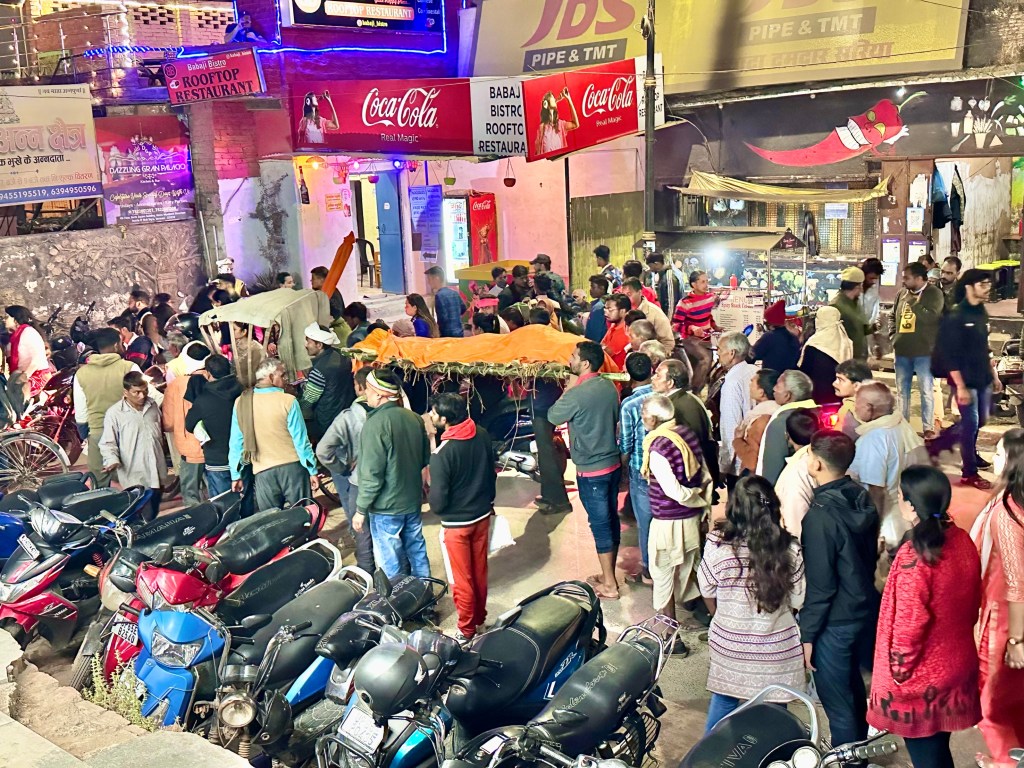
It was total chaos and was the reason that we circle half way round the world, coming back to India again and again. We climbed the two stories to a rooftop Italian cafe, Kharkiv, where our table was at the edge of the roof so that we could look down at the orderly chaos below us with traffic and pedestrians weaving in and out, a man without legs pushing himself on a board with wheels with his hands, a Korean looking group each holding a bright floating balloon to identify their group, children holding the hands of their parents, and motorcycles horns blaring, often with a family of four or five balanced precariously, snaking their way through. We were not in Swannanoa any more. This was the reason we had come to India, not to see the Taj Mahal, not even to see Varanasi, but to sit on a rooftop and let the vibrancy of India sweep over us.
 BILLYBABA’S WANDERING