A DAY IN DELHI
I rested in the Master Paying Guest House all day Sunday, not even stepping out once. I slept and wrote, slept and wrote and didn’t feel like facing the chaos of India. It was good that I did because Monday was full of adventure and, it turns out, of expense.
I took a rickshaw to Nath Brothers Chemists in G Block of Connaught place, the colonnaded circle of shops was the business center of the new capital of India, New Delhi, built by the British in the 1930’s in a very carefully laid out way. It was built not far from the enormous Red Fort on the banks of the Jumna from which the Moghuls ruled India. The Moghuls were moslems who came to India through Afghanistan, builders of the Taj Mahal and Fatehpur Sikri in Agra and whom were so powerful that they barely noticed the arrival of the British when they appeared on their shores as traders in the late 1600’s and then eventually took advantage of Moghul weaknesses and piecemeal conquered India. The commercial center for the Moghuls was Chandni Chowk with its wide avenue leading to the Red Fort with the huge Jamma Masjid mosque to one side. Chandni Chowk is still a very lively place, a huge bazaar, with shops and restaurants of all kinds.
New Delhi with with its parks and wide avenues and laid out blocks of houses with traffic circles everywhere is completely different. It stretches south for miles from Connaught Place with its white columns.
I first went to Nath Brothers Chemists and got medicines that my Medicare Part D insurer wouldn’t let me have in advance. Here doxycycline, lisinipril and metformin cost only a dollar for a months supply and didn’t require a doctor’s prescription or any other red tape. The American price of these drugs is more than 10 times as high, even though almost all the American drugs are produced in India at low cost.
After Nath Brothers I walked to Bonton Opticians where I have been buying my glasses for 20 years. Prescription progressive glasses with frames made in France and the ability to transition to sun glasses when I step outside cost $250. In Asheville they would cost more than $750.
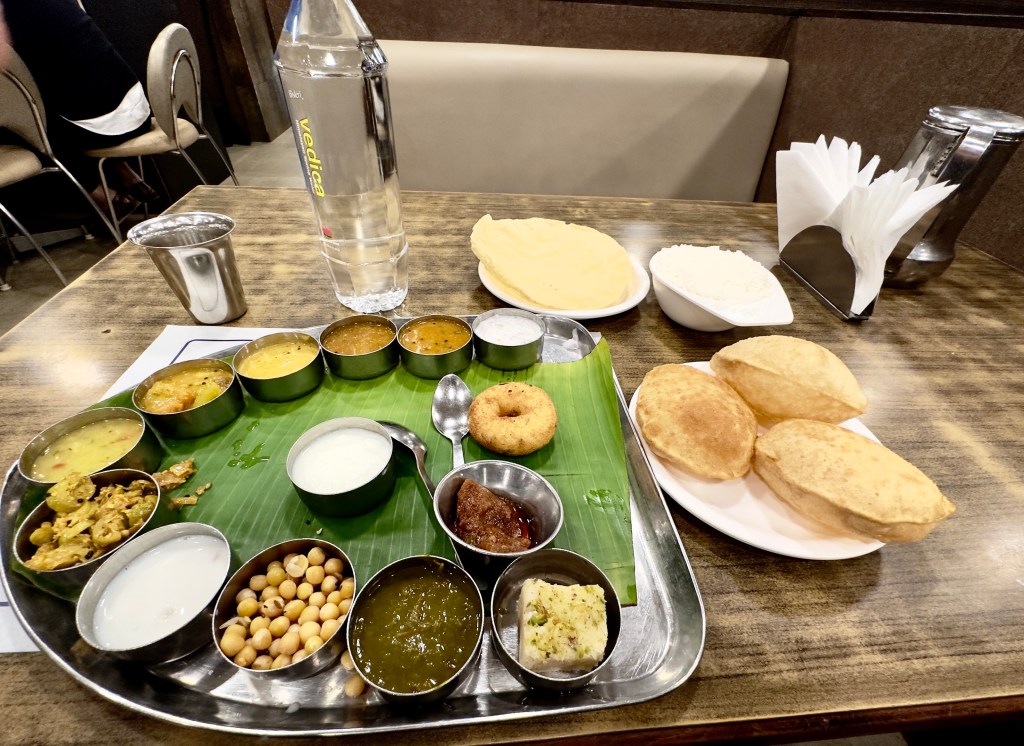
Then I ate a South Indian thali at Saravanaa Bhavan, a franchise that I ate at in Paris three days ago. There were a dozen different curries and sweets with three puffed up puries and rice for $3.50, too much for me to eat. If you live in New York or San Francisco or Texas try Saravanaa Bhavan.
And then I took a motor cycle rickshaw for the forty minute drive to Dr. Kakar’s Global Clinic in Masjid Moth in Greater Kailash II. The traffic was marvelous and even better on the ride back at rush hour. On the wide avenues there are three or four lanes going in either direction, but the way traffic moves in Indian is very unlike downtown Asheville. There are marked lanes but people pay little attention to them and at the traffic circles there is no right of way, everyone threads their own way through.
In fact, to make sense of Indian traffic you should think of it more like pedestrians on a wide sidewalk in Asheville with everyone in a hurry. In India you stay to the left and in the USA you stay to the right simply because it is easier that way. But on the sidewalk there are still a number of people on the left who are about to turn left or are just cutting across and everyone adjusts. Only here it is cars, huge red buses, motor cycles and pedestrians (and in other cities a few cows) mixed in. But even on the right side in Asheville those walking faster cut in and out as they thread their way through, brushing so close to people that we sometime hit elbows. The person in front has the right of way and can swerve left or right and the person behind has to continually adjust to the person in front when they want to pass them. And that is the way it is with the cars, buses, motor cycles and rickshaws in Delhi. Everyone picks their way through traffic, never looking back, darting into any opening but not quite touching, always leaving a foot between vehicles as everyone swerves along. At every stop light, just as pedestrians in Asheville fill every gap and bunch together, here cars and buses and rickshaws crowd together and motorcycles fill every gap. When the light changes everyone blows their horn and tries to start up all at once. There are almost no wrecks here just as we almost never run into anyone on the sidewalk in Asheville even when moving as fast as we can.
Seen this way Delhi traffic makes sense and the riders and drivers can relax, from the American perspective it looks like chaos every moment on the edge of a collision.
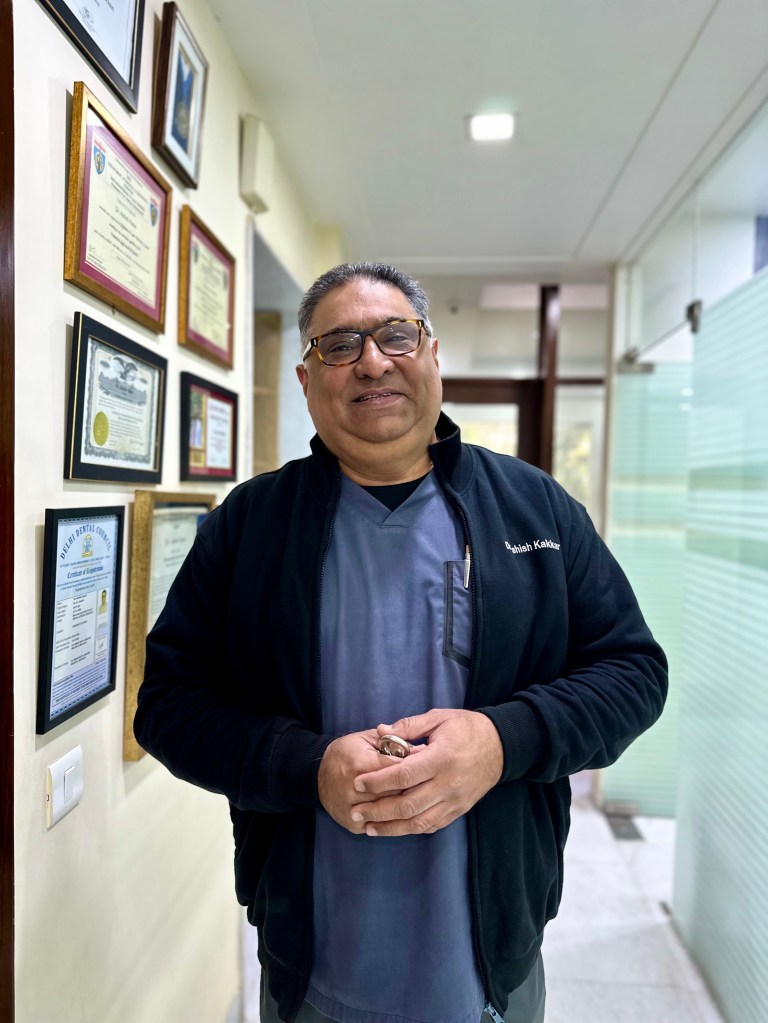
I got to Dr. Kakar early. His waiting room had changed and when I got inside later there was room after room of gleaming equipment. I was there to have a tooth implanted on the lower left side where a gap meant that I could hardly chew on that side. And I was going to have an abscessed tooth pulled on the right side. I was going to shift my chewing from left to right. The implant would cost $1050 and the tooth pulled $50 (in Asheville I estimate $4000 and $500).
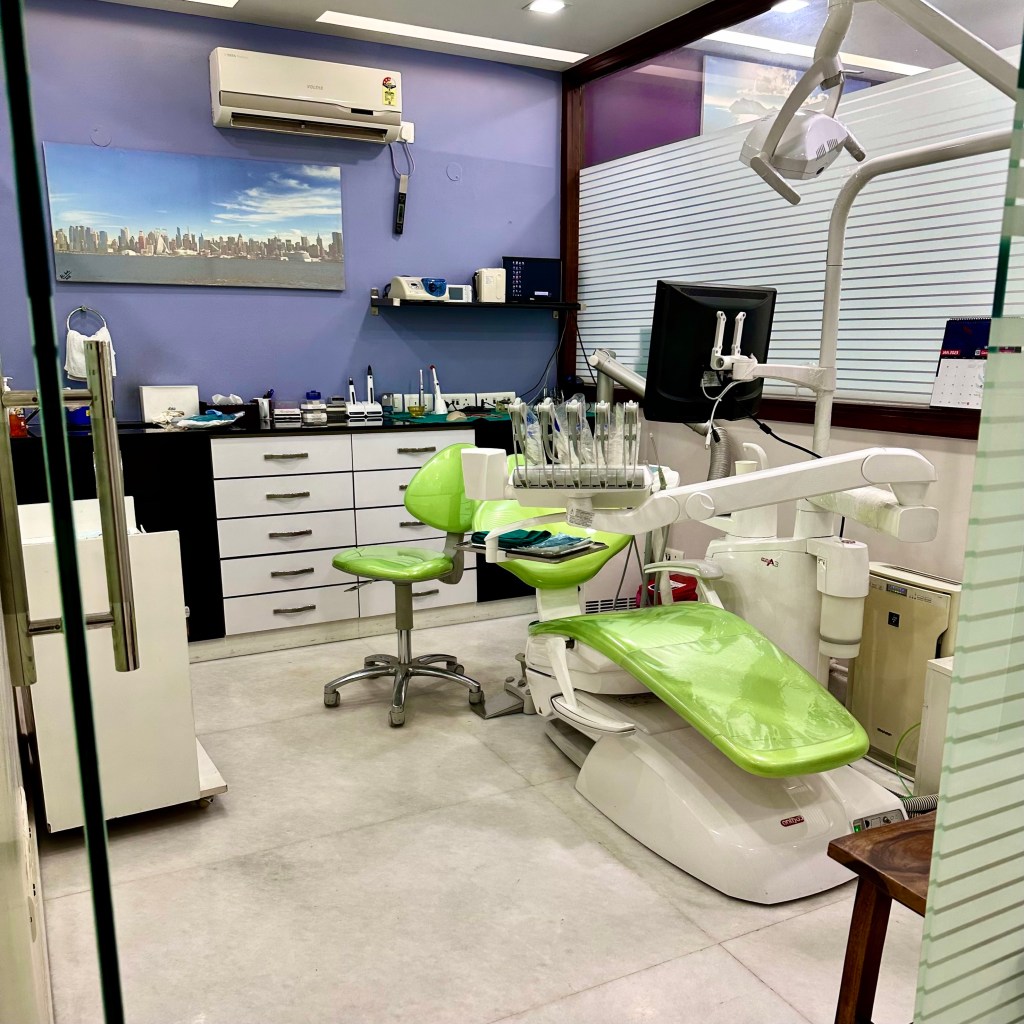
Dr. Kakar had just gotten from Italy an xray machine that circled my head and by which he could measure exactly how long to embed a screwed in plug into my jawbone without touching the nerve canal. He showed me what he was going to do on a large screen. The process required a number of different devices that drilled and thumped and clanged as I tried to keep my mouth wide open and leaned to one side. It was a violent process and required strength on his part and an attempt not to panic on mine. When he was done he beamed. No cuts, no stitches, just the right pressure, a complete success.
Then he xrayed the right side and pronounced that he could save that last tooth on the back, the one I thought needed to come out, and that I would have a root canal the next morning at 9:30 for $400. But he had discovered that the tooth next to it had a gaping hole from decay and would snap off any day. It had to come out. But not only did it have to come out but instead of waiting three months for the wound to heal he could use a laser and clean out the wound and implant a tooth immediately, another $1200 (probably $4500 USA). We could be done by 5 p.m.. So that is what he did. Sure enough, as soon as he touched the tooth it snapped off. He drilled and dug away and in minutes the tooth was out. And then the same clanging, whining, thudding process of putting the implant in. By five I was sitting in the waiting room with an ice pack on my throbbing jaw sure that it would be impossible to sleep at all last night. But a pain pill soothed the pain and Dr. Kakar put me in an Uber and sent me back to the Master Paying Guest House where I ate soft rice and dal and fell asleep early. Now it is 3 a.m. again and I couldn’t sleep so got up to write. I’ll sleep for a couple of hours and then take a motorcycle rickshaw on another weaving ride through New Delhi and find out what a root canal entails. And by the way, he also discovered that my gums have separated from two crowns and so I will have to have two crowns replaced at $350 apiece ($1000+ USA) the next time I come through Delhi.
Another day in the life of an octogenarian traveler.
 BILLYBABA’S WANDERING