HUGE
I read a series of articles in the Atlantic this evening. I only find these articles that upend me because of Apple News, because someone at Apple News scours a wide range of newspapers and magazines and selects articles that that person finds compelling. That person and I must be on the same wave length. I certainly don’t have time to read all those magazines and newspapers and need to have someone to ferret out the articles. This both makes the Internet a wonderful thing and extremely helpful for me but, I’m guessing, that someone is doing the same for dedicated MAGA people, continually linking them to and firing them up with articles on new conspiracy theories. And that, from my perspective, also makes the Internet a sinister place.
Again the articles that touch me are popularized science which translate scientific discoveries that I cannot hope to understand into ways of understanding the world that startle me and turn my world upside down.
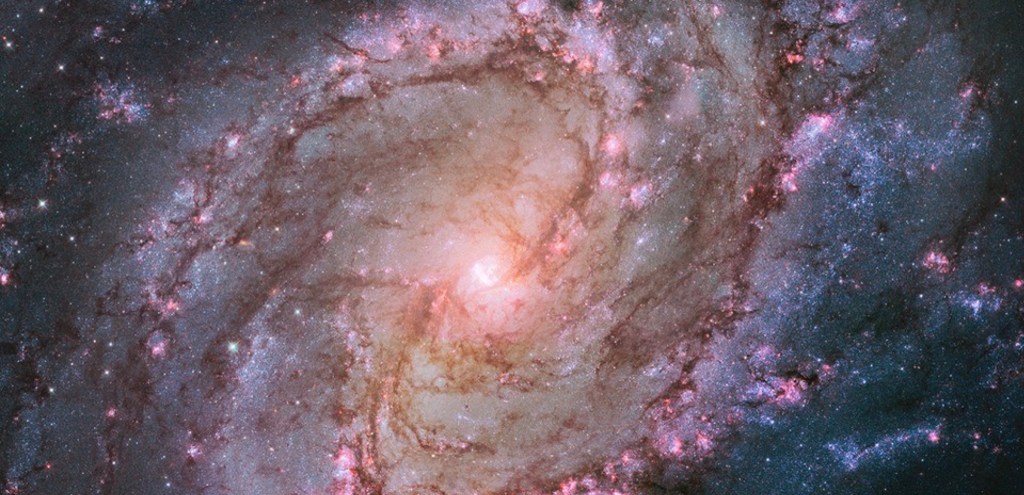
An Atlantic article dated December 3 called “How Vast is the Cosmos, Really” is actually a series of articles. The first is about the size of the universe which suddenly in the last month or two thanks to the James Webb telecope allows us to peer so far away that formerly empty spaces in the sky are now filled with galaxy after galaxy, billions of stars. And while we can’t see into the future, in a way we can. We are certainly able to look into the past and to go back 13 billion years or so, so that if we were to turn the telescope around and looked from those distant galaxies at us we would see our galaxy as it was 13 billion years ago, if it was even there then. We are living far in the future of what that telescope would see. So all of a sudden the universe seems infinitely enormous and time is completely relative.
I don’t have to understand that at all. But the attempt even to imagine one galaxy with its billions of stars let alone billions of galaxies, all a product of the Big Bang means that we are lost in time, a flicker of an eyelash, and lost in space.
Then a second article complicates this much further. It’s thesis is that we only know the planet or galaxy or universe that has over billions of years evolved to the point that humans can actually create the James Webb telescope and observe the universe.
Our assumption is that the slow process of evolution has been a pretty much benign set of circumstances that have led very slowly to us. But actually it is very likely that all the other possibilities of the development of the universe or universes led to dead ends in which there was too much dark matter or too little leading to wiping out those universes with either possibility. Planet after planet which could have had life was blown to bits in grand collisions. Our universe and our planet is just the one rare and lucky planet that survived with the right conditions for life of any kind with human life being the wildest of possibilities.
We don’t see the dead end alternatives, we just see that we are here, through extreme luck, and that seems normal to us. As Alan Lightman put it, in the universe the number of places where there might be life are one chance in billions, like a few grains of sand in the whole expanse of the Sahara.
It really isn’t necessary for me to understand the science, any third grader could see that the human race, and certainly each individual member, is insignificant and here by chance in an incomprehensible universe. It is such a huge realization that neither the third grader or I can bear it for long and have to shift back to thinking that my own passage and the life force that regulates every part of my body and that impels me unconsciously along is what is most significant in the universe with nothing else mattering much at all even as I know that other people feel the same way about themselves.
 BILLYBABA’S WANDERING