LOCAL TRANSPORTATION
When you travel without a car local transportation matters a great deal and varies enormously from country to country. In Paris and London the bus and subway routes were easy to manage. In Paris I got a month long pass which made both very easy. But in spite of that Susie and I had to walk a great deal at either end of the routes because taxies were very expensive and often not available. London has a way of topping off a card whenever it ran low so it was easy to use both systems.
In America reliance on the car by most people means that even in big cities it is difficult to get around. In San Francisco I had to walk a lot and wore myself out. Maybe it would have been easier if I had known the system better.
I know that Asheville has a number of bus lines and have seen people at bus stops. I have never in 50 years ridden on an Asheville city bus. I think in Asheville the bus is considered a poor person’s accommodation, just as Greyhound, which I rode on a few times this summer to make connections with trains is considered a poor person’s option. Most people get around by car, which is very convenient and also very inefficient and energy consuming and adds to global warming. We have developed a system in which people live far from the places they regularly visit such as the grocery store, post office, doctor’s office, and general shopping. Our strip malls along highways are built on the premise that everyone has a car. This is very convenient, but it means that we devote a great amount of space to parking and roads which seem to be widened every few years to accommodate everyone. Even Asheville has a number of bottle necks such as Interstate 26 South of town whose traffic is backed up because it is so hard to get through Asheville. And there doesn’t seem to be any solution. Asheville is trying to add bike paths to the existing system. In Europe the bike paths were put in when the roads were first designed, in the United States it is now vry expensive to add bike paths and the attempts to squeeze bicycles into existing traffic is not very safe. In a number of German villages and in other parts of Europe there is a good network of preexisting bicycle paths and the centralized layout of towns mean that everything you need is within a narrow area so kthat people can do much of their local transportation by bicycle or even walking.
While American cities are hard to get around in with point to point transportation, cities like Delhi or Varanasi have a number of forms of transportation in which a person can go directly from one place to another, which in America can only be done by car or expensive taxi. General traffic in cities in India is slow in any case and cycle rickshaws and motorcycle rickshaws can link you from place to place easily. Delhi’s new subway system means that you can make longer legs of a trip cheaply and efficiently by subway and then the last leg by rickshaw.
But one problem with the Indian rickshaw system is that driver’s try hard to evade the use of meters resulting in bargaining before every trip, even when the rider knows what the correct fare should be.
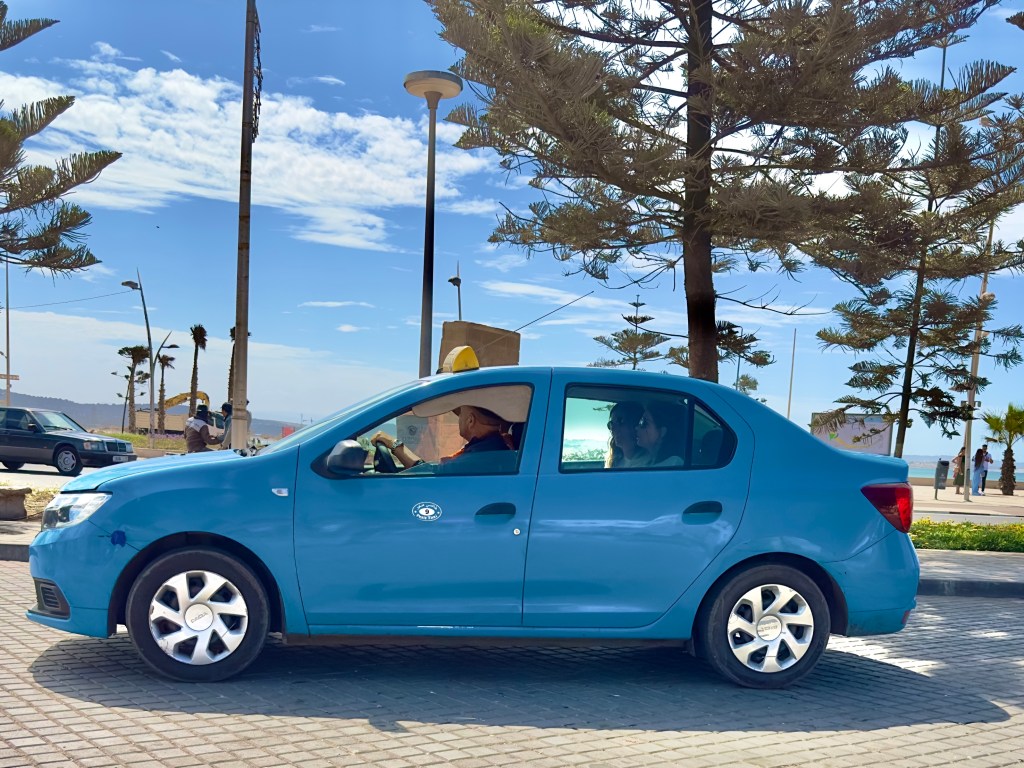
All of this is a long way around to introducing the bright blue petit taxi system in Casablanca and Assaouira. In Casablance there were certain standard fares, when you knew what they were, which of course I didn’t. But in Assaouira there is an even simpler system which for a foreigner makes getting around very simple. Every ride costs 7 dirhan per person, 70 cents, no matter where you are going in town. This allows a driver to pick up people along the way and deliver each person where they want to go as long as it is in the same general direction.
It is hard to describe, when you have experienced all of these other forms of local travel, each with their complications, to say how simple and easy this is. The petit taxi system takes away all the hassle of haggling and yet lets every one make a point to point connection. There are no buses in Essaouira, no trams, no subway. Either you walk or go by petit taxi. In a town where most tourists don’t have a car and there is no where to park a car if you have one this is an ideal solution to local travel.
I discovered this when I wanted to go two miles to Carrefour and return with a load of groceries. I just asked on line how to get around in Assaouira and was informed of the 7 dirhan standard rate and all of a sudden getting around was no longer a problem. I didn’t have to look on Google to find a bus route, I didn’t have to hassle over the price. I got in a blue petit taxi soon joined by another person (limit of 3) and was dropped off at Carrefour and when I was done got a ride back to the stone gate of my choice into the Medina, after which I had to walk since the lanes are too narrow in the Medina for motor vehicles of any kind.
This may only work in a town, such as Essaouira, that is not very large with no long rides possible and a town where it is the standard way of getting around with no competition. But it certainly works well here.
 BILLYBABA’S WANDERING