RAY SMITH AND THE SMITH SWIMMING HOLE
My grandfather, Martin Luther Mosher, was an agricultural extension agent connected with the University of Illinois. His life work was assisting in the development of hybrid corn and spreading the word on how much more productive it was than the older kinds of corn which used the seed from the last year‘s crop for the next year‘s crop. Hybrid seed corn was grown by seed companies as seed from specially developed corn and then sold to farmers who planted and harvested it and bought more seed the next year. The new corn has stronger stalks, fuller heads of corn, but required the special seed and fertilizer. It was almost an artificial corn.
My father went to the University of Illinois where he followed in his father‘s footsteps and spent his life promoting better crop practices first in India, where he was an agricultural missionary and then around the world with the Agricultural Development Council, part of the Rockefeller Foundation. He met my mother at the University of Illinois through her brother Bill who married the sister, Aunt Mary Lou, of my father Lute‘s wife, Aunt Dee. Through his brother Lute and this convoluted marry go round my father met Alice Wynne Hall, my mother.
This led to my father and mother marrying and going to India to the Allahabad Agricultural Institute. All new missionaries to India were expected to learn the local language before beginning their life‘s work, in this case for my father, Hindi.
Missionaries were scattered all over India and needed a school with an American curriculum to send their children to. Because summers were scorching on the plains of India, an American boarding school, Woodstock School, was built in Landour, a hillside next to the British hill station, Mussoorie, at 7000 feel in the lower Himalayas with views behind it to the snow capped highest ranges of Himalayas. The Landour Language School was also in Landour, occupying part of Kellogg Church at the top of the hill.
The director of the Landour Language School was Caldwell Smith who was married to Betty. They were a handsome and vivacious couple and became good friend of my parents. The houses the two families lived in on the steep Landour hillside were close to each other and when my parents came to Mussoorie in the summer they socialized a lot with the Smiths.
And that is how Ray Smith and I became friends. We were the same age and were both born in the Landour Community Hospital. It was entirely by chance that we became friends and when I think about it now it was the closeness of our families and the small classes at Woodstock, there were only ten boys in my class, that brought us together.
I realize now that we were were very different people and had very different interests and yet we became very good friends because we shared our growing up in India together.
This is a kind of mystery to me, how we come to connect with people, but for the rest of my life I have thought of Ray as a very good friend, a best friend. A friend is a person you can talk with, a person you can trust, a person who cares about you. Not having common interests didn‘t seem to matter. When Ray died in Monrovia a year ago in April, one week before my wife died in Swannanoa, North Carolina I felt a huge double loss. And this is odd because I had been with Kathe almost every day, except for trips to India, for almost sixty years and in those sixty years I had only seen Ray two or three times. Neither of us were letter writers but when he unexpectedly died I felt as if I had been connected with him all of this time.
Or course, I hadn‘t, and when I visited Elaine last month I discovered that Ray had lived a life that I knew nothing about and that the person I thought he was was the boy that I knew in India. But that didn‘t make his friendship seem any less real.
Ray was a doer and a maker, a very practical guy with a wonderful smile. I am a dreamer and a wonderer, more interested in poetry than tools, and as impractical as Ray was practical.
Ray‘s family lived in Redwood Cottage, revealing their California roots which was just above our Presbyterian mission cottage of Tehri View. Because the hillside was so steep every house was build on a cut out plot with a steep hillside above and a pushta, a high retaining wall below. I remember small Redwood Cottage with its small porch and small kitchen with small living room and I think three very small bedrooms. But it was the bathroom that I remember most vividly because even though there was running water in the house there were no flush toilets in Redwood Cottage. Instead there were three commodes with curved wooden seats and a fold down cover which hid the tin pot below that would fill up and then be taken invisibly by a servant and deposited somewhere. It odd now but somehow it worked. Most of the activity of the house took place in the small living room or on the outdoor porch. The activities I remember most clearly were Betty or Ray cooking up fudge in the kitchen or a group of us playing caroms in the living room in which we would flick round wooden pieces that would hit others and lodge in the pockets on the corners. But I remember Ray‘s house always being a warm and friendly place. Ray had an older sister, BJ, Betty Jean and a younger brother, Dick, who was just a twerp to Ray and me in those days but is a twerp no longer.
The experience with Ray’s family that I remember most vividly took place during the ten day summer school vacation. Because Ray‘s father, Caldwell, was the director of the year long Landour Language School, Ray‘s family lived in
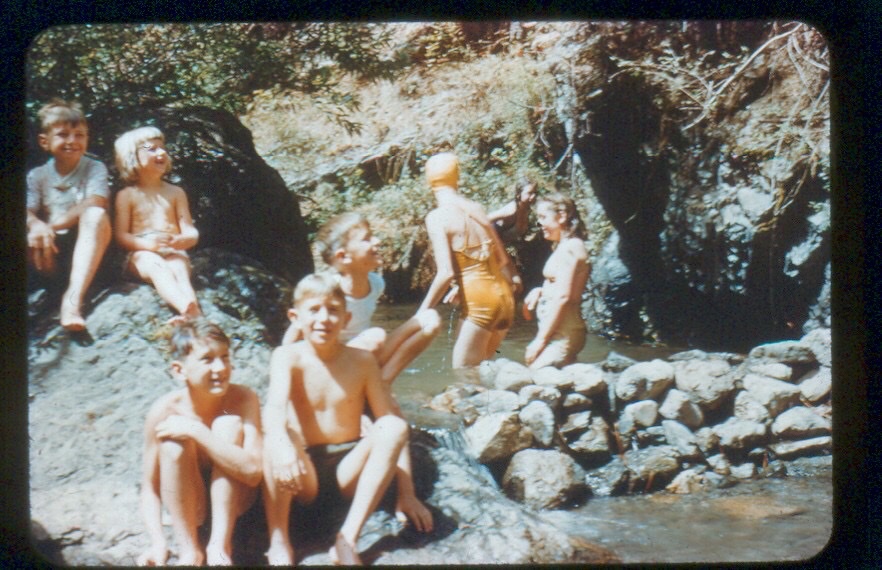
Redwood Cottage year around, except when the school would move to the warmer plains of India during the cold Mussoorie winter when it often snowed. But the fathers of the other mission families would work year around on the plains of India, even in the oppressive heat of the summer, and would come up to Mussoorie for the ten day summer vacation. The mothers would come up for the hottest four months bringing their children out of boarding to be day students. It was during these four months that I would stop by Ray’s house or we would play basketball at the outdoor Woodstock School court just below his house. But it was during these ten days when we could be with my father whom we only saw otherwise during the three month winter vacation that we would go to the Smith‘s swimming hole. The Smith swimming hole which was out the Tehri road and then down a steep path to a stream, maybe a five mile hike, where we would camp out with servants bringing the food in a huge basket, all fresh food, potatoes and onions and tomatoes, and enormous load, that a cook would cook up. Camping was a complicated process. We dammed the stream with large rocks and made a shallow pool maybe three feet deep and six feet wide and ten feel long that we children could swim in. It seems to me that we stayed there, sitting around a campfire at night, swimming during the day, for five days at a time, but maybe it was only two or three days. However long it was it is one of my fondest memories of my growing up in India.
 BILLYBABA’S WANDERING