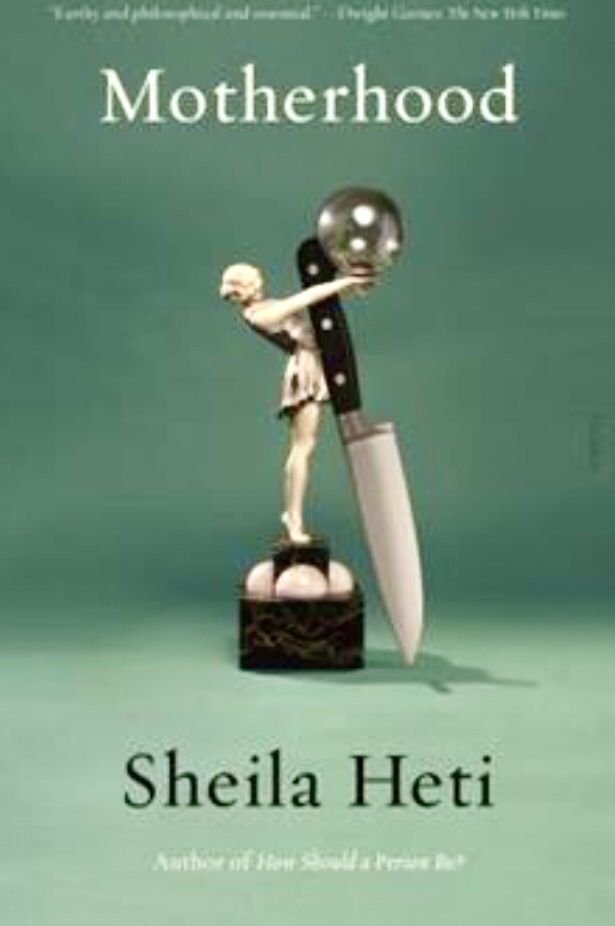
MOTHERHOOD
I‘ve read two of three novels by Sheila Heti that I plan to read. I‘m reading them in reverse order. Pure Colour, Motherhood, and How Should a Person Be. She has written other books as well. I got started with just published Pure Colour because a New York Times article about it intrigued me, I think because hers is such an odd, but strongly felt, way of looking at the world which affirms for me that I can look at the world in my own way whether banal or odd, it doesn‘t matter. She affirms looking at things from her own, my own, experience.
Motherhood is certainly not my experience at all. I am drawn to her vision for two reasons. The first reason is because I just like being in her company as she feels her way through the very intense question for her of whether in her late thirties she should have a baby and commit to motherhood or not. She looks at the issue from both sides, going back and forth, and then affirms her intuitive feeling that while it is right for some women, it is not right for her. There is no plot although there is a dramatic question to be worked out. It is hardly a novel in the conventional sense. But what I like most of all is her conversational way of talking with herself as she looks at the issue from every angle as well as circling around the same perceptions again and again, looking at them again and again before making up her mind. So what I most like about her novel is her way of presenting her feeling along. It is all internal and I have the feeling that this is the way that she actually feels her way through life. I just like being in her presence.
But this brings up two issues for me. I looked her up on line and on Wikipedia found a quote.
“Increasingly I‘m less interested in writing about fictional people, because it seems so tiresome to make up a fake person and put them through the paces of a fake story. I just—can‘t do it.“
I also found a reference to an article that seemed to complain that Heti’s form of fiction isn’t fiction at all. The critic, called it autofiction, autobiography disguised as fiction. He noted the absence in this kind of writing of well constructed plots and strongly imagined characters.
And that got me to wondering. I am not so much interested in whether the way she writes is fiction or not. What I am interested in is how deeply imagined events and actual events touch me, how alive they seem to be. This probably depends upon how intensely real they feel to the author. Heti’s comment above finds imagined plots and characters to be tiresome. The critics perspective is that actual events are more mundane and not as intensely alive as deeply imagined stories. But my personal experience as a reader is that whatever the unconscious response is within me that it is touched by either kind of story and doesn’t much care which is which.
An example of this is that a really good movie seems intensely real to me. I think of the recent movie by Kathe’s niece, Maria Schrader, I am a Man, Ich bin ein Mensch in German. One of the two main characters is a not only a robot, he is a virtual robot. Actually, he is an actor who has been in a number of movies including Downton Abbey. But the script was written by Maria and Jan, her man. They dreamed it up. Maria was the director and I know all of the scenes were acted over and over with coffee breaks in between until the actors got it right. And when I looked at it on my iPad I could see this robot character but could also see the flat screen of the iPad. The character wasn’t really there. He was streamed somehow in a digital way and the pixels were reconstituted on my iPad. It isn’t the technical side that interests me, it is that when watching the movie I disregard all of this unreality and feel the robot character is just as alive as if he were sitting in front of me. Whatever visceral response is going on within me, it disregards all of this, and responds in an intensely emotional way. Heti is right, the whole process is artificial, the critic is right, a well imagined story touches with intensity.
Or turned the other way around. When teaching I read many student journals in which young people have felt their way along through the intense years from childhood to adulthood. The mythic journal they are making of exploration sometimes leads to pain or dead ends and sometimes leads to their feeling intensely alive. These are stories of actual events and actual feelings and they also touch me with intensity. These are not my mythic story, they show me just as much what could be in life, almost what can be imagined when making our passage, as actually imagined stories. In fact, to me they are imagined stories as people imagine their way through life.
As a rational critic I can tell the difference between fiction and actuality, but whatever within me is being touched by intense emotion cannot. They are both the same. The student journal of the story of their passage is no different in its effect than a novelist’s dreamed up story.
There are a couple more issues connected with this that I wonder about.
One is that in Heti’s Motherhood I know exactly what she if thinking and how she thinks. I can feel her circular and almost random process of thinking. But I am not sure that the way she describes the world around her is actually as she describes it because the way she sees the world colors what she sees. Other people probably see the world very differently.
In many novels what is out there is described in an objective way. If I were there I would see what the author sees. That is realism. But when the author or the narrator says of a character that she thinks or feels this or he was thinking or feeling that, I realize this is actually very artificial. When I look at how I think, how I am thinking right now, there is actually no thinking process until the words hit the page. If you were to look at me you would have no idea what I am thinking. Even as I don’t know what I am thinking until I open my mouth or see the words appear on the screen in front of me.
This may be an odd distinction to make. But the fact is that my inner visceral response doesn’t care. I believe the author when she tells me what someone is thinking although the narrator couldn’t possibly know. And I trust the journal writer’s perception of the world even though it is colored. Both sides are artificial and both are very real. Autofiction and fiction are two different ways of telling a story. Heti’s way of feeling along, the journal writing way of feeling along, are just as real and just as imagined as Dickens realistic way of feeling along in a story.
In addition, I have a wonder, without exploring it further just yet, whether maybe what some critics call real fiction with a dramatic plot is really a masculine way of looking at the world and if Sheila Heti’s journal like conversational approach to story telling is more femininine. Maybe I am completely wrong, so I’ll have to think about it.
So these are my responses to the way that Heti tells her story, which I really like. But it is the second part of my response to Heti’s book that I was trying to get to, the decision about whether to have a child, that also touched me deeply. I’ll get there tomorrow.
 BILLYBABA’S WANDERING