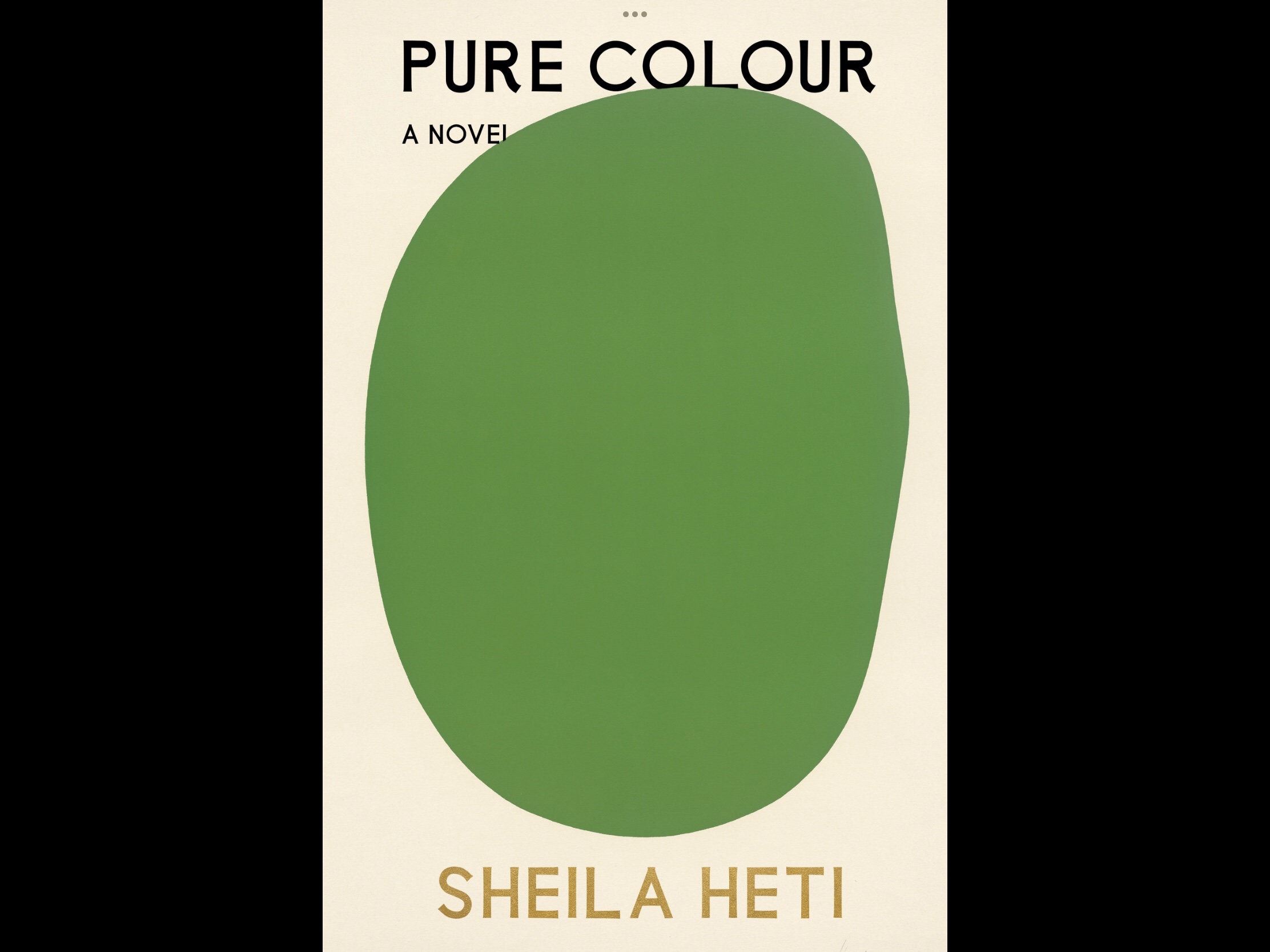
PURE COLOUR
I just finished reading Sheila Heti’s Pure Colour. It is a short novel with almost no plot that doesn’t take long to read. While reading it I thought of William Blake, a seer, a person who can see better than others, who described in detail visions he saw in long epic poems and engraved what he saw with hard lines around the figures because they were so real to him. He insisted that the angels dancing on his mantelpiece were really there. He created an entire mythology of his own, or rather he saw an entire mythology and he engraved it and wrote a poetic response to it.
Sheila Heti’s Pure Colour seems very Blakian to me, or rather both she and Blake are describing the world the way it vividly appears to them.
I don’t wonder if any of Blake’s figures actually exist or whether Heti’s response to the world makes sense. I have no idea if it is Heti’s view or her main character Mira’s view. It doesn’t matter. This is Heti’s way of perceiving the world or the narrator’s, who could be Heti but maybe not at all, way of viewing the world or Mira’s (the main character), an imagined but very real character, view of the world. It doesn’t matter. This is one response to the world described in as complete detail as Blake’s mythological world seen by someone making her way through the world.
Heti/narrator/Mira perceives that God failed on his first attempt at creation and is about to wipe the page and start over again. In this first version of creation, that we are living in now, there are three kinds of people. Birds, Mira, those who stand back and respond to the beauty of the world as art critics; bears, her dying father who loves intensely, in this case loving Mira, and care about nothing else and fish, her friend Annie, who care more about people as a whole and about social justice than individuals. During the story Mira wonders about what the death of her father feels like to her, about what it means for the two of them after his death to enter into a leaf on a tree by a pond and to have conversations with each other, and then to wonder about the unfolding of her love for Annie who fishlike only cares for her when Mira is dying. That is the whole plot, but the plot doesn’t matter, what the plot feels like to Mira is what matters. Mira, the bird critic, is trying to make sense of life.
Luckily I am not a critic. I don’t have to make sense of the book or even wonder what it means. There are long discussions about evolution, God appears to be an awkward creator, nothing bears any similarity to what is considered actually real. From a common sense
Sancho Panza perspective Heti/narrator/Mira appear as nuts as as Don Quixote or Blake lounging around naked in his garden seeing vivid visions or mythical figures he dreamed up himself.
I don’t have to deal with any of that. What I like about the book (and about Blake) is that both affirm what it feels like to pass through the world in your own idiosyncratic way. We all know what we are expected to believe or to feel, but what does our passage actually feel like.
Years ago Jean Hutton attended one of my classes. She was the librarian at Warren Wilson College at the time. She had been introduced to a way of understanding human behavior and not only wanted to share it with us but was convinced it would make our lives better. It is one of many paths to enlightenment that I have been exposed to, all of them the one way the one truth and the one life and all of them different. The students listened respectfully and dismissed her. I listened and felt that this way of looking at the world fit me perfectly. It was dreamed up by a guy who lived around here somewhere and at a yard sale I found the book he wrote and bought it. I never read it. I also forget what the particular branch of psychology the ideas came from. I don’t think the guy was even a psychologist.
None of that mattered. It was a four quadrant theory, with four main ways of dealing with the world. There were the upper left analyzers, the upper right doers, the lower right empathizers, the lower left sensual artistic responders. If you knew where you were on this chart you could understand yourself better and people who were unlike you better. It was very practical. To tell you the truth, I’m not sure that I even have these categories right because as time has gone by I have probably filled in the blanks and created my own categories.
I’ve tried to explain this in class a few times and everyone went glassy eyed, so I dropped it. I haven’t tried to explain it to my friends, because they would begin to wonder about me. It is as cuckoo as Blake’s mythic figures or Heti/narrator/Mira’s birds, fish and bears. And just as real to me as Mira’s vision to her or Blakes’s to him.
So what touches me about Pure Colour is not whether it describes the human condition accurately or whether it will be useful to me. What touches me is that it lets me accept Mira’s very idiosyncratic passage as being real for her and my own idiosyncratic passage as being real for me. It doesn’t matter whether in these posts I am describing the tensions in the world accurately or whether my personal solutions are useful to anyone else or whether I turn people glassy eyed. What matters is that the posts help me to accept my own idiosyncratic passage.
 BILLYBABA’S WANDERING