DUKKHA AND DINOSAURS
I thought this post would be simple but it has gotten me more and more confused. A few days ago I listened to a podcast on Dukkha on the Be Here Now webpage where there are a number of podcasts on Hinduism and Buddhism. If you really want to know what Dukkha, the first noble truth of Buddhism is, listen to this podcast by Joseph Goldstein. Dukkha. Don’t listen to me because I am really trying to understand my own experience and when I try to apply Joseph Goldstein’s thoughtful and clearly stated explanation I get confused. Stop right now and go listen to him. Dukkha, as I understand it, is a sudden realization that came to Siddartha, a prince who had abandoned the palace and courtly life to discover the basic truth of life. He wandered for years searching for it and, not finding it, sat down under a Bo tree and vowed not to move until he found it. That’s the story I heard. And what he found was Dukkha. Dukkha is the awareness of suffering, or misfit attachment, or the impermanence of everything.
Anyway, not sitting under a Bo tree and as confused as the next person, this is the very simple thought that came to me that I am trying, somehow, to link to Dukkha.
This is my very obvious to anyone revelation. It is the awareness that in my old age I seem not to be able to hold on to anything. Holding on to Kathe, who has been gone for eight months, makes me despondent. I can’t hold on to her. In fact a few days ago I sensed a presence, it felt like Kathe, saying in an irritated voice “Just let me go, let me go,” as if she were tired of being held on to. I don’t know if this really was Kathe or if it was simply my inner voice telling me that hanging on was doing me no good and I ought to let go. I actually don’t know if I heard anything at all but this was what I sensed and what I have been thinking about since.
I have one photograph of Kathe as a 23 year old looking at me across the room. I have another of Kathe as an 80 year old looking quizzically at me from the same distance. I have been sorting digital photographs lately and often run across photographs of Kathe, I have hundreds of them, almost always smiling and looking radiant. But I also have photographs of her as she lay dying with sunken cheeks and her eyes rolled back, haggard and pale. I’m wondering if she (or I) is telling me to let go of her as an old dying woman because she doesn’t want to be remembered that way and instead wants to be her quizzical 80 year old or wants to be herself as a young lively woman just starting out on life before coming to America. When in Winsen a couple of months ago I walked by the second floor apartment of the school where she grew up, the streets she walked, the church she loved to sing in, the river where her brother drowned. I was in her girlhood presence before I knew her. That was the Kathe who so touched me inexplicably the first time I saw her.
But I realized in Winsen that I couldn’t hang on to that Kathe, either, or hang onto her wonderful father and mother who were so alive long before Kathe was born. That world is gone and I have let go of it. I have let go of my mother and my father and in the last ten years of my brother, Ted, and my sister, Anne.
I see all of them in the photographs that I am looking through. In fact, all of the photographs, even the photographs of the houses that I made yesterday and put in a post, are of the past. Someday, and it won’t be long from now, if people look at those photographs they will be looking at Asheville as it used to be, back when they first built quaint wooden houses on Sunset Mountain, a few of which by that time will be being restored and preserved by the Asheville Preservation Society who will be trying to preserve, hang onto, the old traditions of Asheville before they are made obsolete by new computer printed houses, made in a day, from virtual plans or maybe after the great earthquake of 2029 that leveled Asheville or who knows what when people look back in 100 years or 1000.
I read an article yesterday that the earth, with its molten center is cooling 1 1/2 times as fast as expected and that in millions, maybe billions of years, it will be cold as a cinder and life will vanish.
In the long run we can’t hang on, in the short run we can’t hang on, either. Everything changes and changes, nothing is permanent. That is my understanding of Dukkha the first noble truth.

Fifteen years ago I took photographs of Warren Wilson students in front of a white sheet in lower Gladfelter. I invited students to dress as they pleased and to get their photo taken. About 100 did. It was a project of my Digital Story Telling class and the purpose was to show people what Warren Wilson style was like in 2007, what their 2007 style will look like in 50 years when they are 70 and grandparents to similar kids in wildly different costumes. Only 15 years have passed and those in the photographs must already smile at themselves. These photographs will be tomorrow’s post. The past is already sliding away and I wouldn’t be surprised if one or two have died by now and are no more part of the living dead but have shifted over to being the dead living. I think that is Dukkha.
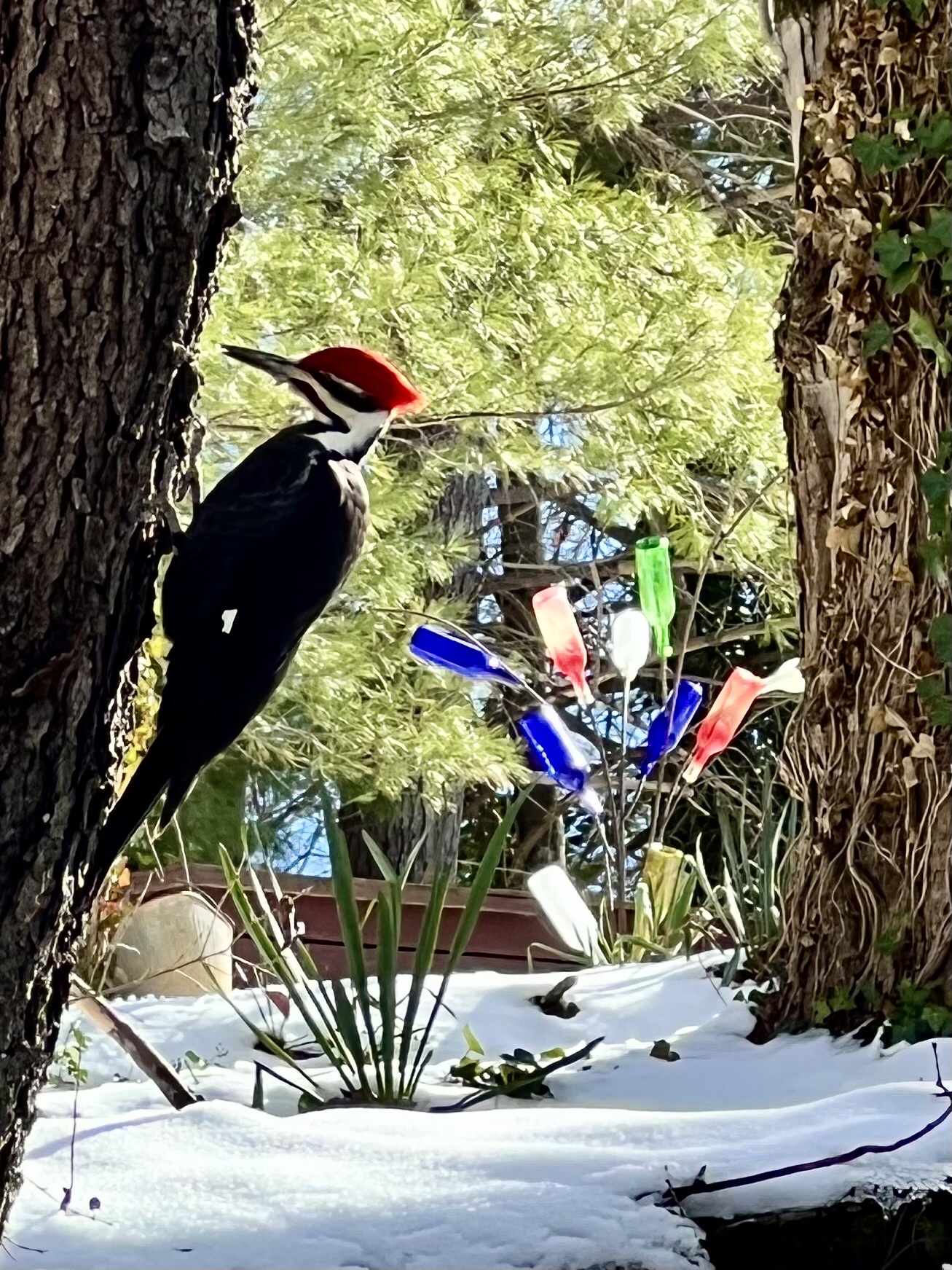
Another reoccurring fantasy of mine fits in here also with my wondering about Dukkha. It is a life long fascination with dinosaurs. As a child I was hooked by them, all of the different lumbering purple giants, swift two legged killers with rows of gleaming white teeth, longbeaked feathered flyers floating overhead, one of which we saw yesterday on Sunset Mountain.
They were here for ever and ever, millions of years, covering the earth, surviving extinctions and coming back in new forms, here much, much, much longer than humans have been here, longer than even mammals have been here, at least as I’ve understood their story. And now, except for the birds they evolved into, they are gone. I imagine myself transported back to a moment by a warm lake in the eons and eons before we humans blipped onto the scene as generation after generation of every shape of dinosaur lived out their lives and left their footprints. The thought haunts me. I stand at the lakeside and feel a huge emptiness and purposelessness and pointlessness at the impermanence of everything. I think that is Dukkha.
I can’t hang on to Kathe as she (or I) tells me to let go, just as I have to let go at the end of each day as it slides into the past. Something in me looks forward and moves forward with drive and purpose and fools me into thinking I am permanent.
I read an article recently in the Atlantic magazine by a neuro scientist who was told he had a benign tumor, then when operated on was told he had six months to live. He is trying to tell what it feels like as a neuro scientist to have six months to live and why he feels this way. It doesn’t feel so bad, he says, because one part of him doesn’t accept death. But the neuro scientist part does. His explanation is that the human brain is constructed to preserve our body and to drive us forward with emotional drives beyond our conscious control. And one of the functions of the brain is to focus on the future, to watch out for what might harm or help us, to live partly in the imagined future. The brain isn’t programmed to recognize death. Our brain doesn’t believe in death. It is always moving us forward. Maybe that is why Kathe died quite without fear. She was still moving forward. She was protected by her brain.
But his conscious brain does know that he is going to die, that we are all going to die, as the dinosaurs lived and died, as the earth is going to turn to a cinder and die. That is Dukkha. Everything is impermanent. And that is what Buddhism gives us, a way to live with and to accept dukkha, impermanence, that Joseph Goldstein is much more aware of than I am and better able to deal with.
 BILLYBABA’S WANDERING