ATHENS
Finally I am over jetlag enough to take a photograph of my dinner tonight and of the restaurant in which I ate. I am beginning to come to life again after being bleary eyed and numb with tiredness for two days.
The first day I took the Gray Line city tour and got a sense of what Athens today is like. Today I climbed the Parthenon and saw the Acropolis and then visited the beautiful Acropolis Museum, thinking of my friend Ron Wilson the whole time, who died two years ago. He made a study of Greece and Rome and would have been prepared and gotten much more out of it than I did.
This is what I got out of the first two days. The first day I was driven by Grey Line down street after street. Occasionally an historic sight would be pointed out, but my main impression was of a city that had expanded rapidly since WW2 with hastily constructed and very ordinary looking buildings. It reminded me of New Delhi but without the wide streets and rows of trees and many parks and green areas and in places bicycle rickshaws and horse drawn tongas. My feeling was that I was glad that I was spending just a few days in Athens and would spend most of my time in Greece with the wide beaches, beautiful white, rounded traditional Cylcadian houses. This was tempered a bit by the outdoor restaurant scene which crowded the sidewalks forcing
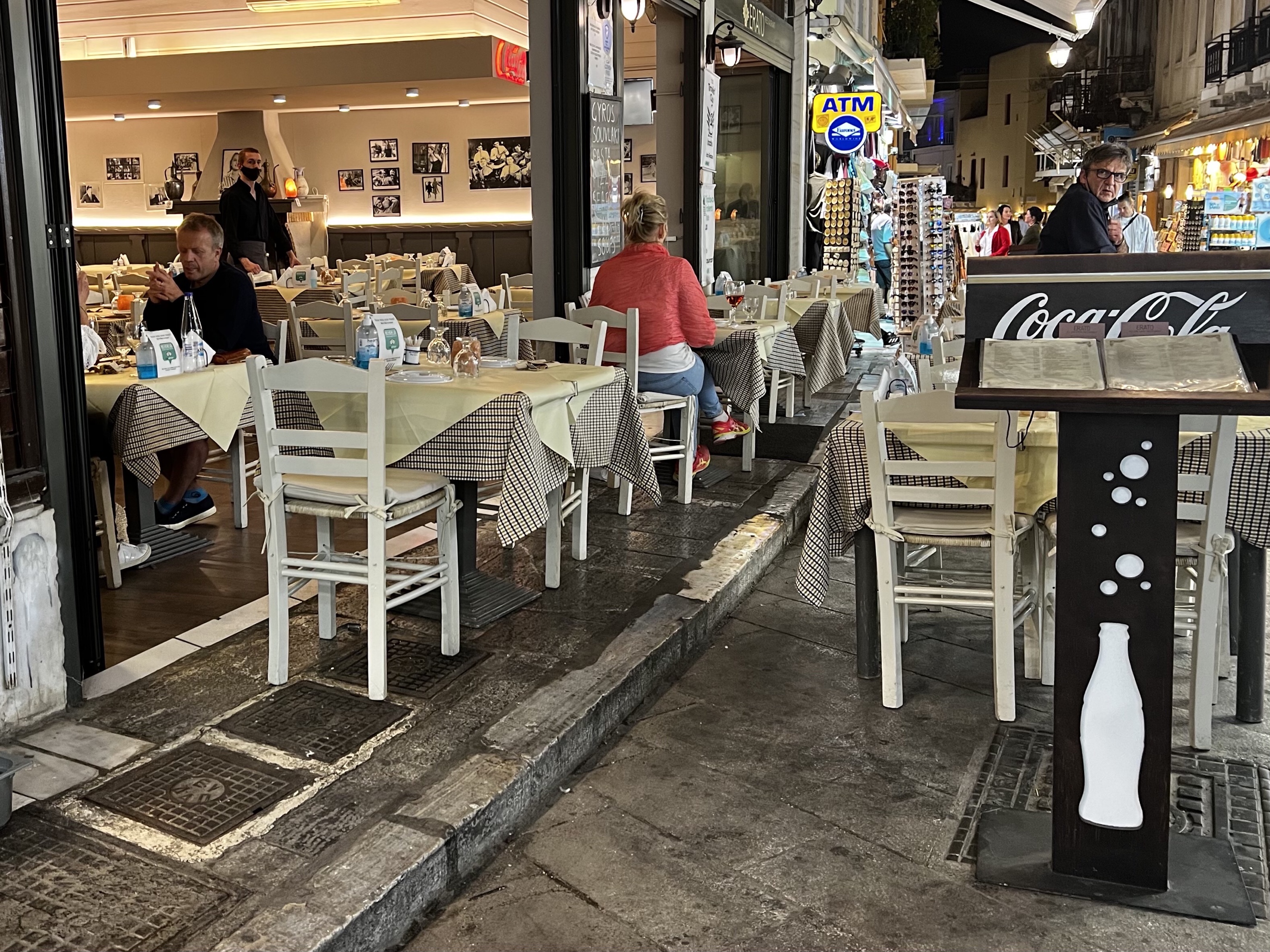
pedestrians into the street. The three dinners I have had have been delicious and it is fun sitting on the sidewalk at 9 when the evening gets started in Athens and watching the people, mostly tourists I’m guessing, walk by. Tonight I sat in the Epato Cafe on brightly lit street catering to
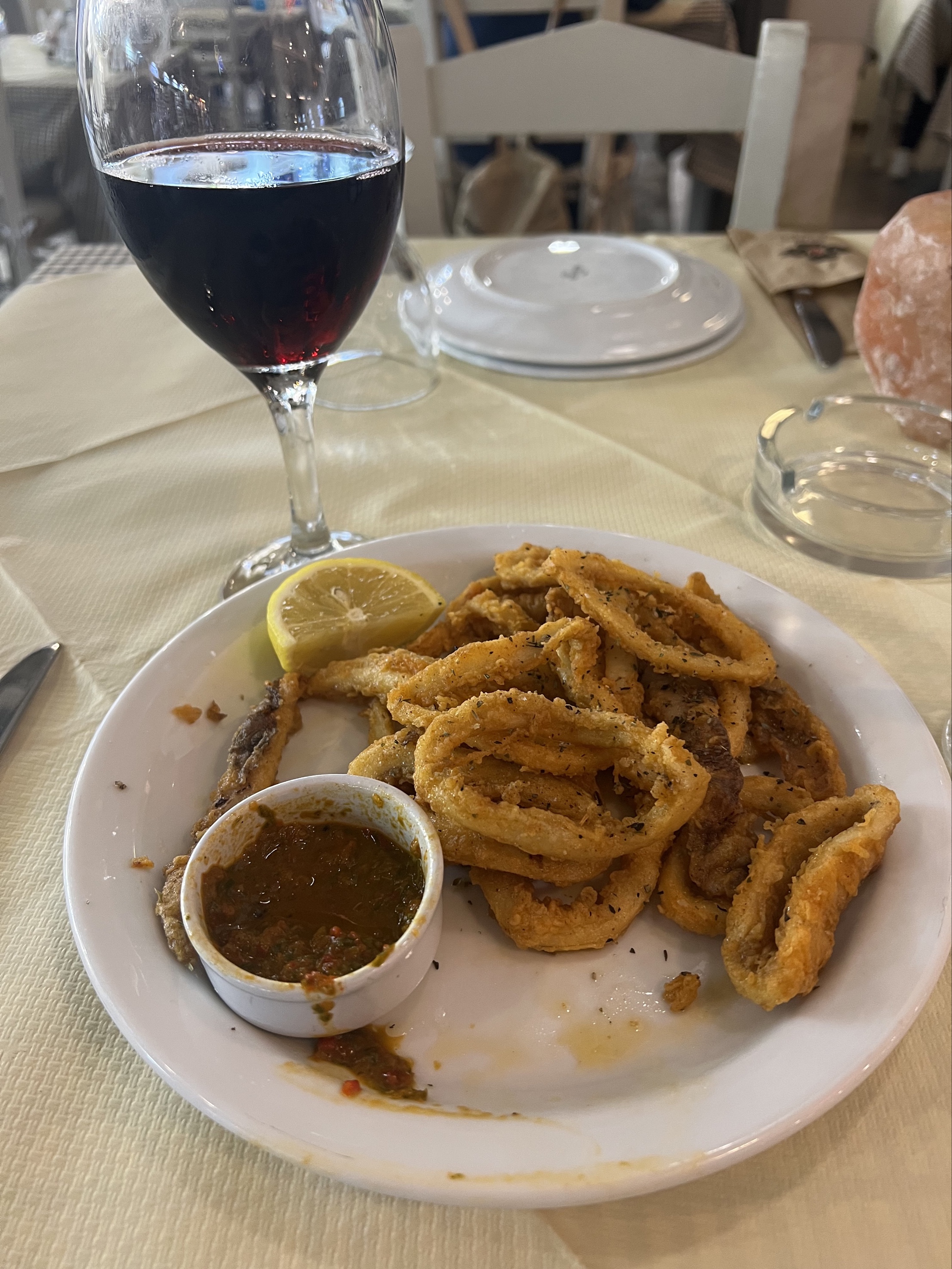
tourists. I had delicious fried squid, calamari, about $10, which I messed up a bit before remembering to take a photograph and a large glass of red wine.
So my impression on the first day is that the restaurant scene is electric and the architecture is dowdy.
Today I toiled up to the Acropolis, the central feature of Athens for 3500 years with it’s central feature, the Parthenon.
I had been in Athens for one day about fifty years ago when bumped from a flight in Rome and given the option of spending a day in a hotel in Athens. I don’t remember the city at all and the Parthenon was a great disappointment although the way up has been transformed and
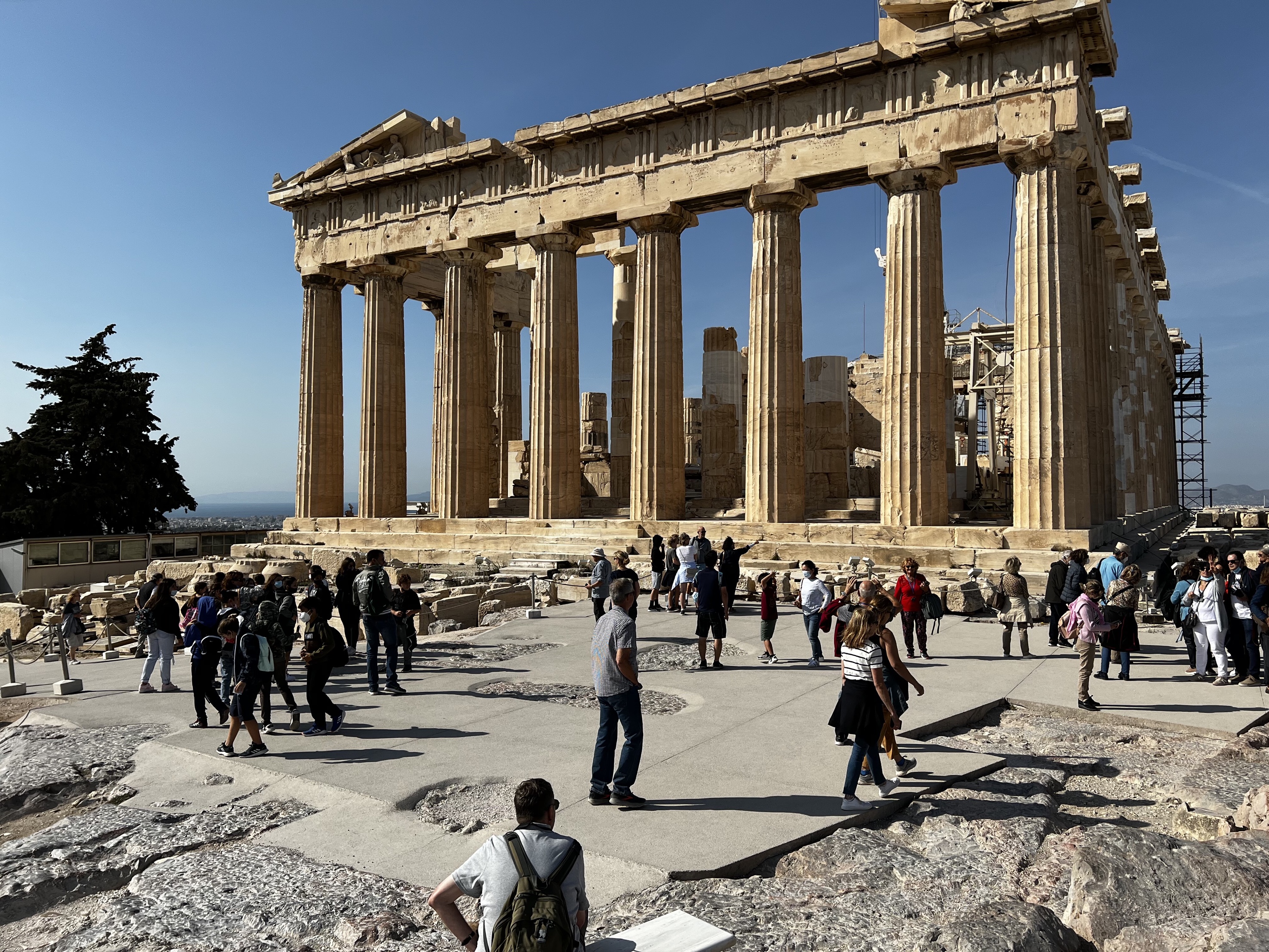
modernized. It was a very hot day, I climbed upward over rocks dotted everywhere with tour groups guided by sign carrying guides. I only got half way up when the heat and the crowds of tourists got to me and I retreated. This time I climbed all the way up taking photographs as I went, circled the Parthenon twice and then walked down to the new modern Acropolis Museum which houses and protects all the important collected carved marble from the destruction by explosion when in 1687 the Venetians were shelling the Turks who stored their gunpower in the Parthenon causing the Parthenon to explode into shards. Now only exact replicas are being used in the restoration of the Parthenon, which is only half way done, with the originals being protected in the Acropolis Museum.
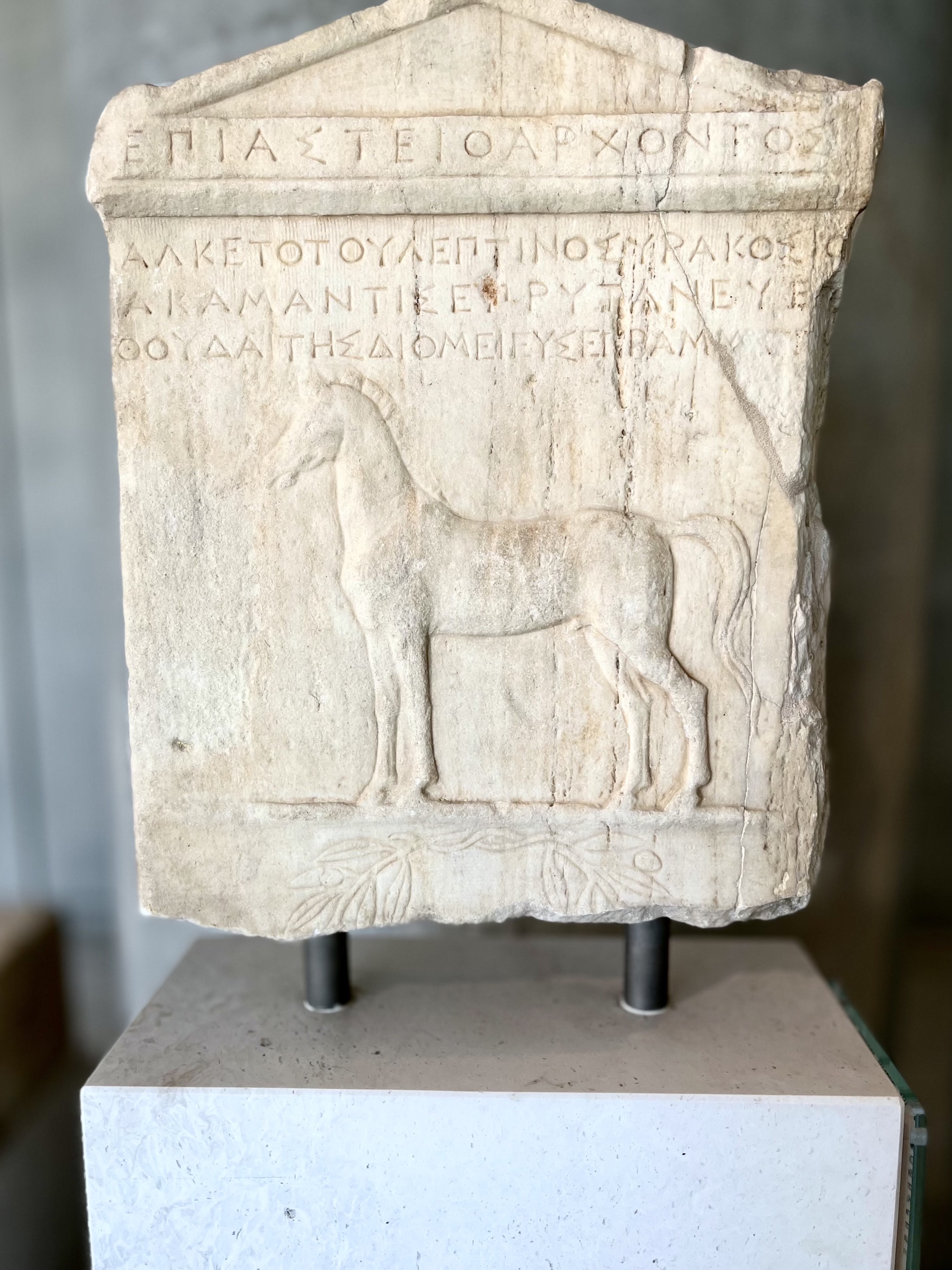
First I was disappointed that all we could be sure of was a few damaged and broken sculptures. We were asked to imagine everything. Mostly we were lucky to see the foundations of long since destroyed temples. It seemed a forlorn project.
But then I saw the stone stepped theater where Aeschylus presented the

Oresteia and sensed the presence of Socrates, Plato and Aristotle on this hill and thought of the the way they founded and were the inspiration for much of Western Civilization. The high flat rock topped by the flat plane of the Acropolis must have looked much the same when they taught here.
And then it began to dawn on me that the reason the Acropolis is in ruins and is being restored is because it has been a sacred place from 3500 BC. In that time it has been destroyed and rebuilt again and again, by the Persians first of all and then by the continuing conquest from the outside including by Sparta, the Turks and many others. Warfare, ruin and destruction is part of the history of Acropolis, interspersed with centuries of grandeur and rebuilding. This restoration is only one of many. And even the buildings of Athens, which depressed me, are only temporary and will vanish and a new Athens be built. I couldn’t expect to look down on Athens as it was in the time of Pericles. Over 3500 years everything is temporary except for the central significance of the Acropolis which remains powerful.
And the reason it has been rebuilt again and again is that it is central to Greek identity and pride. But also because the gods worshipped here, with Athena, from whom Athens got its name, being most honored, were every bit as intensely alive and powerful and demanded worship, in the way Jesus in all his representations is central for fundamentalist Christians. Greek mythology is not just a literary mythology that found its way into Western art and literature, this is “the way, the truth and the life” as fundamental as Christian mythology which most Christians don’t think of as mythology at all.
And so, after thinking I would be bored by the Greek insistence on hanging on to the old ways, to a jumble of rocks, because this was their lost time of glory, I suddenly felt, as much as I able to on a three day visit, a sense of the intensity of Greek mythology and worship in Greek life and realized that over a course of 3500 years erosion and destruction is normal and has to be lived with. In comparison to the United States, only four centuries old with rapid change during that time, Greece, a civilization that has stayed vibrant ten times as long will have been in constant flux. This is what I would ask Ron tomorrow, if he were here, and I were with my men’s group. But instead I struggle along on my own after only three days of snap judgments on Athens. Susie arrives tomorrow and we take the ferry to Paros.
 BILLYBABA’S WANDERING